
Nonreligious Worldviews and the Benefits of Existential Certainty

By Luke W. Galen, Grand Valley State University. May 18, 2026.
We live in a time where uncertainty abounds. Concerns related to political, economic, and environmental instability undermine our ability to plan for the future. Where do people turn to make sense of these events and to find comfort in the midst of vulnerability? Decades of research suggest that people rely on their worldviews to help them find peace and make meaning. But as we’ll soon see, not all worldviews are created equal.
Some (but not all) non-religious worldviews address existential concerns
“Why are we here? What happens when we die? How can we know what is true? What constitutes moral conduct?” Answers to the “Big Questions” of life can be found in a range of worldviews. These address such things as the existence of metaphysical entities, how truth is perceived, and guidelines for proper conduct (Koltko-Rivera, 2004). Strong worldview convictions can provide a sense of meaning, control, and purpose. Worldviews based on religious beliefs are commonly thought to uniquely satisfy these existential needs. Concepts of personal immortality can provide assurance in a literal afterlife, which, for many, is preferable when compared to a lack of certainty or the belief that consciousness is terminated upon death.
However, many nonreligious worldviews can offer equivalent ways of meeting existential challenges. Although some secular beliefs simply negate that which is affirmed by religion, it is simplistic to view all secular beliefs as being alike merely because they lack religious or spiritual content. This would relegate a diverse range of concepts into a common residual category. Some secular worldviews represent the affirmative endorsement of epistemic or ethical content entirely distinct from religion and spirituality. Secular humanist tenets, for example, assert that logic and reason are the most effective tools for understanding the universe. Scientific knowledge also features prominently in nonbelieving worldviews (van Mulukom et al., 2023).
Non-religious worldviews can buoy well-being
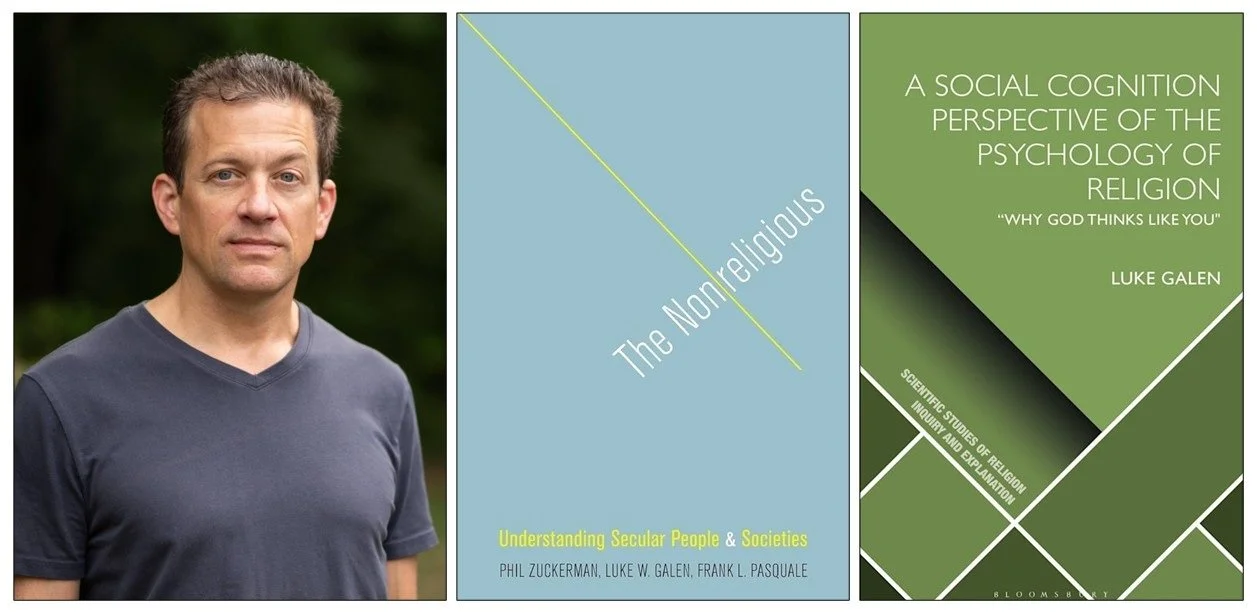
In my recent book A Social Cognition Perspective of the Psychology of Religion: Why God Thinks Like You (Galen, 2023), I suggest that many psychological benefits thought to be produced solely by spiritual worldviews are not exclusively derived from religious content. Though they may take religious forms, the resources most relevant to addressing existential challenges derive from basic underlying secular concepts and modes of thought.
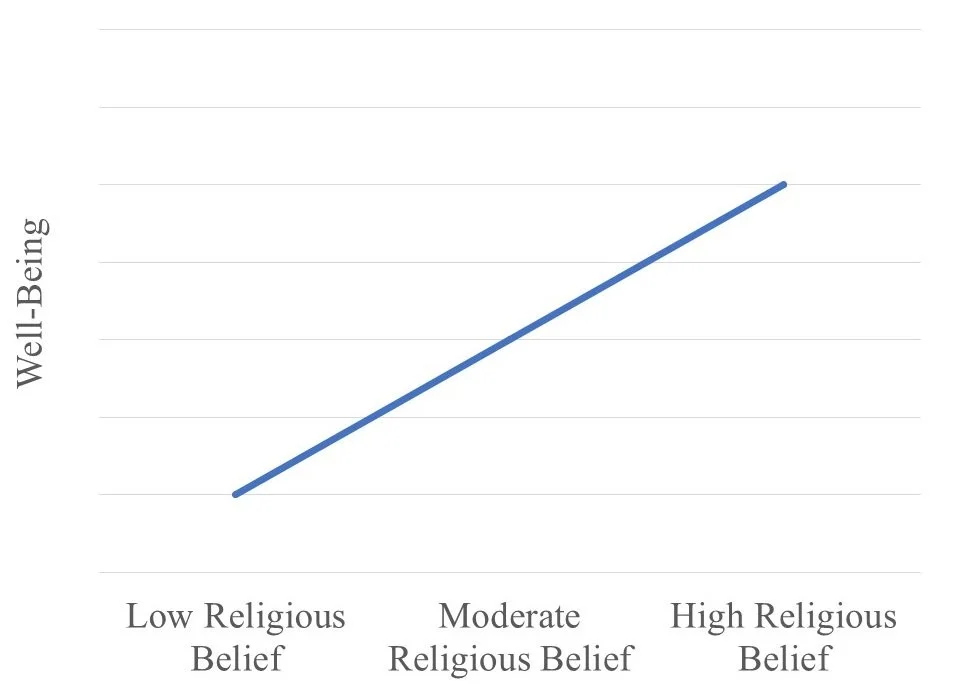
Figure 1: Linear Relationship Between Intrinsic Religious Belief Strength and Psychological Well-Being.
Numerous studies have indicated that outcomes such as mental well-being functioning are associated with having an “intrinsic” religious orientation – deeply internalized beliefs central to one’s identity. When conceptualized as a linear continuum (Figure 1), high intrinsic believers tend to have greater life satisfaction and happiness compared with low or indifferent believers. Similarly, frequent religious service attendance (compared to infrequent attendance) has also been found to lead to psychological benefits. These findings are typically interpreted as suggesting that human flourishing is a product of belief in religious worldviews.
However, intrinsic religiosity represents an amalgamation of more than one construct: strong convictions and commitment to practices that also incorporates religious content. This combination is not, however, unique to religion, but rather shares qualities with some (not all) nonreligious orientations such as affirmative atheism and secular humanism, which also incorporate clear, coherent beliefs, strongly endorsed as meaningful.
By contrast, the worldviews most distinct from both intrinsic religion and intrinsic secular humanism/ atheism are belief systems with ambiguous content endorsed weakly or indifferently. In contrast to the linear religious belief model, this can be conceptualized as representing a continuum of overall worldview conviction, with high religiosity and nonbelief at opposite poles, and nominal or unsure belief in the middle (Figure 2).
The advantage of this distinction is evident when psychological outcome variables are assessed as a function of both religious and secular worldview beliefs.
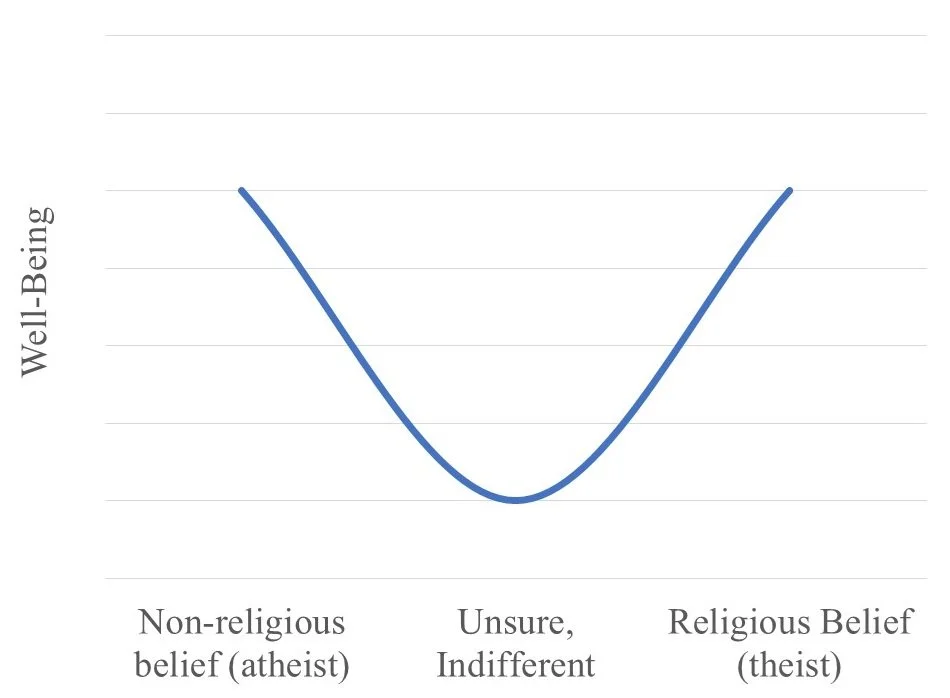
Figure 2: Curvilinear Relationship Between Worldview Conviction and Psychological Well-Being.
For example, I conducted a series of studies comparing groups of church members with organized nonbelievers (members of secular and atheist organizations) on outcomes such as life satisfaction and emotional stability (Galen & Kloet, 2011; Galen et al., 2015). The participants were asked about beliefs ranging from absolute certainty that God exists to absolute certainty that God does not exist, with uncertainty representing the midpoint. The psychological outcomes followed a curvilinear function such that both strong religious belief as well as strong nonreligious belief (e.g., atheism) were both linked with better outcomes compared to uncertain belief conviction.
Dozens of other studies have also found this type of “U-shaped” relationship with worldview conviction (Moore & Leach, 2016). In one review of studies featuring identifiably religious as well as nonreligious participants, out of four papers testing curvilinear relationships, all found them (Park, 2019). Other studies comparing religious and nonreligious self-identifications indicate that well-being is lowest among agnostics and the spiritual-but-not-religious and highest among both atheists and the religious (Karim & Saroglou, 2023). Such results support the interpretation that those with uncertainty and doubt in their worldviews have more difficulties with mental well-being.
Non-religious worldviews can also provide existential benefits
Similar patterns are seen in the existential domain of death anxiety. A central tenet of many religious and spiritual worldviews is that the personal soul survives into the afterlife. A strong belief in immortality is commonly presumed to have advantages in buffering death anxiety. Conversely, given that most atheists believe that personal consciousness is extinguished upon death, it is often assumed that nonbelievers experience a sense of nihilism and terror. However, it has been surprisingly difficult to establish empirically that greater overall religiosity has an association either way with death anxiety. As with mental well-being many studies find that death anxiety forms a curvilinear relationship – low at the (non)religious extremes, high in the middle (Jong et al., 2018).

This pattern is consistent with broader terror management theory perspectives in that both religious concepts (e.g., personal immortality), as well as strong secular beliefs, can equally function to buffer potential anxiety raised by the contemplation of death. This also illustrates that such benefits are not exclusively products of specific belief content but derive from having strong convictions in a comprehensive worldview.
It may also be that worldviews exert impacts on mental well-being for different reasons at different points along the continuum of conviction. For example, strong religious belief may reduce fears of death via specific immortality concepts. At the opposite end, those with no religious beliefs could construe the end of life as a natural endpoint, without any negative associations. By contrast, uncertain, nominal believers may endorse some religious concepts (e.g., an afterlife, a judging God) but reject others (adherence to strict moral codes) in combinations that decrease well-being (e.g., fears of rejection by God) – in effect, the “worst of both worlds.”
Other existential issues can also be addressed by secular worldviews in a manner equivalent to traditional religious concepts. Humans tend to desire a sense of control and agency, which for many is derived vicariously from belief in the existence of a controlling, omnipotent, personal god with whom they can interact. This concept is not endorsed by most nonreligious people, who believe in a naturalistic universe operating without any intentional controlling agency.

Secular humanism can be summarized concisely as the combined pursuit of knowledge and compassion: to learn as much about the natural world as possible and to use that information to make the world a better place, both for ourselves and others.
But the nonreligious can derive a sense of control via alternate routes. One such source is via endorsement of institutions like effective governance and competent political systems. Science represents the construct perhaps most associated with nonreligion (van Mulukom et al., 2023). Atheists and agnostics are more likely than the religious to endorse science as a way of deriving knowledge about the world as well as a source of control, order, and meaning. Experimental studies show that anxiety can be managed via the belief in scientific theories that provide a sense of structure and purpose (Rutjens & Preston 2020). Belief in a clockwork universe can provide a sense of predictability and order.
Humans have a need to view their lives as having meaning and purpose, and when these needs are satisfied, well-being is greater. Conversely, those whose lives lack meaning or purpose tend to suffer from anxiety and depression. Religious belief is associated with a greater sense of global meaning and purpose. Many religions incorporate concepts that imbue life with transcendent purpose, such as the belief that events are organized by the deity (even if the purpose is unknowable by humans). As a result, linking global meaning and purpose to some religious concepts approaches a tautology because the latter are defined similarly to the former.

For example, belief in a personal theism—an all-powerful god who intervenes in the world and is accessible—is tied to the belief that one’s life is part of the divine plan. By contrast, nonbelievers are less likely to perceive objective meaning or purpose in the universe. They also differ in how they assign value to meaning and purpose, and what they perceive as the sources of such things. Whereas religious individuals tend to construe life’s meaning as externally derived or exogenous, atheists are more likely to believe that meaning is endogenous or internally provided (Speed, Coleman, & Langston, 2018).
Although low perceived meaning is associated with lower well-being among religious believers, among nonbelievers this is less true. For atheists with a strong commitment to secular humanist worldviews, the absence of perceived overall meaning in life does not coincide with lower well-being, nor does it result in a crisis of meaning (Schnell & Keenan, 2011). Likewise, when atheists feel a sense of insignificance on a cosmic scale, this is not accompanied by despair (Spitzenstätter & Schnell, 2025). Rather, to the secular humanist, the construal of one’s life as meaningful is contingent upon subjective and personal factors.
These views are partially attributable to different ways of construing “life meaning”. Whereas meaning of life refers to a cosmic, exogenous sense (e.g., Are we here for a reason?”), meaning in life refers to sources found in our own individual life. One could, for example, reject the idea that existence is governed by a higher power, yet still believe that one’s choices bring subjective meaning. This latter view is unrelated to religious beliefs and is the component most associated with greater well-being (Fuhrer et al., 2026).
Exemplars of Atheist Existentialism and Secular Humanism
It is relatively uncommon to see nonreligious views of death and meaning represented in a positive light in culture, literature, or film. Atheists are depicted as being amoral or nihilistic, often in contrast to more sympathetic characters whose worldviews articulate exogenous meaning (e.g., “everything happens as part of God’s plan”). However, some depictions of secular worldviews have been cast in a more admirable light, where humanistic beliefs act as sources of prosocial motivation.

Counterclockwise from center top: Ernest Hemingway and his For Whom the Bell Tolls (1940); Albert Camus and his The Plague (1947); and the films 28 Years Later (2025) and 28 Years Later: The Bone Temple (2026).
Existentialist exemplars include characters such as Robert Jordan in Ernest Hemingway’s For Whom the Bell Tolls (1940) and Dr. Bernard Rieux and Jean Tarrou in Albert Camus’ The Plague (1947). Although living without the exogenous meaning derived from religion, these characters obtain a sense of meaning and purpose from engagement in socio-humanist causes.
Likewise, in the recent films 28 Years Later (2025) and 28 Years Later: The Bone Temple (2026), the character of Dr. Ian Kelson is an atheist who espouses humanistic principles. Kelson (portrayed by Ralph Feinnes) lives an isolated life amidst a zombie apocalypse. Having no living human medical patients, he engages instead with two projects. First, he gathers the bodies of the dead to construct a massive bone temple as a memento mori - a memorial to the victims and a reminder of death as well as the importance of life. Second, rather than killing the zombies, or as he calls them, “the infected”, he uses his knowledge of medicine to search for a cure. Kelson’s worldview, including his atheism and his belief in science, represents an alternative to the violence and nihilism of his environment. With no belief in the hope of an afterlife, Kelson says in one scene that “There are many kinds of death… and some are better than others. The best are peaceful. Where we leave each other in love." Kelson believes that all those he encounters, living or dead, are equally deserving of dignity. His actions are not understood by many of the other human survivors, who view Kelson with suspicion. But his projects provide him with a sense of meaning and purpose.
Secular forms of positive social engagement
Social engagement with others is an existential need that traditionally was addressed via religious institutions where individuals could derive a sense of belonging and fellowship from a religious community. Religious concepts are highly effective at promoting group-based identification via multiple mechanisms including shared sacred binding values, and distinctive modes of presentation, such as dress, diet, and ritual behaviors. However, as nations develop economically, they tend to secularize, with nonreligious institutions fulfilling roles formerly occupied by religious institutions.
According to existential security theory, religious beliefs and institutions provide psychological and social coping resources only under difficult or unstable living conditions, whereas these resources are not needed in easier living conditions, leading to lower levels of religiosity (Norris & Inglehart, 2004). As a result, the most stable and developed societies on the planet tend to also be the least religious. Countries with low overall levels of religiosity also feature societal prosociality such as greater interpersonal trust and lower violent crime rates.
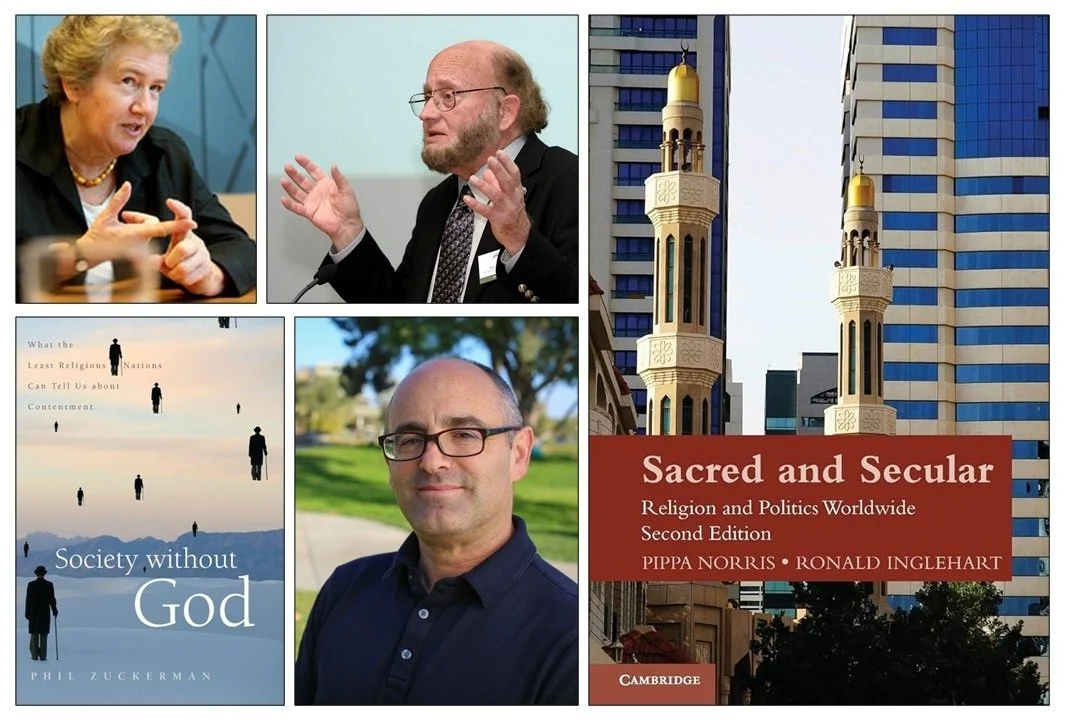
Clockwise from top left: Pippa Norris, Ronald Inglehart, and their book Sacred and secular: Religion and politics worldwide (2004); Phil Zuckerman and his book, Society without God: What the Least Religious Nations Can Tell Us about Contentment (2008).
In Society without God: What the Least Religious Nations Can Tell Us about Contentment (2008) Phil Zuckerman recounts how most people living in predominantly atheistic Scandinavian nations have little need or concern for concepts such as belief in an afterlife or exogenously provided meaning. Rather, Nordic people instead prioritize other sources of meaning such as family, careers, and personal projects. These observations call into question whether concepts of global meaning or literal immortality are necessary components of well-being.
As mentioned above, it has often been assumed that specifically religious forms of social engagement represent the mechanisms of social cohesion for these desired outcomes. On the one hand, it does appear to be relatively more difficult to organize individuals around shared non-belief, as observed in the relatively low membership in affirmatively nonreligious groups. Many atheists object to the idea of “church substitutes,” seeing no need to affiliate on the basis of what they do not believe.
However, several studies have indicated that many of the benefits accrued from religious attendance can be obtained from secular humanist groups. For example, in one such group, the Sunday Assembly, participants report increased feelings of social communion and positive affect (Charles et al., 2021). In my own research, members of organized secular groups experienced positive outcomes indistinguishable from their socially organized religious peers (Galen et al., 2015). Such results indicate that, regardless of metaphysical belief content, people can benefit from engagement with others who share a meaningful worldview in settings that provide support and consensual validation and foster a sense of community.
Balancing confidence in worldview belief while tolerating ambiguity

Aside from the metaphysical content of worldviews (e.g., whether religious or atheistic), factors such as the structure of beliefs and the way worldviews are held, are more relevant to outcomes, whether intrapersonal (e.g., well-being) or interpersonal (e.g., tolerance of different others). People differ in their preferred relative degree of structure versus ambiguity in worldview beliefs. Those who need clear, unambiguous, and unchanging answers are likely to gravitate toward strong, rigid socio-political or religious views (e.g., extremism and fundamentalism). By contrast, those with a higher tolerance for ambiguity and uncertainty adopt worldviews that are flexible and open to change (e.g., “Questing” orientations).
Both types of preferred belief structure come with advantages as well as disadvantages. On the one hand, believing that one’s values and preferences are fixed, and derive from an unambiguous authority seems to produce a greater sense of personal meaning (e.g., seeing one’s life as mattering), but it also leads to devaluing others with differing views (Womick et al., 2021). Conversely, those with flexible belief systems are more tolerant of others but often pay a price of lower personal well-being (e.g., existential anxiety). Thus, strong worldview beliefs, while in many ways personally advantageous, may be disadvantageous in terms of interpersonal harmony (Van Tongeren, 2023).
Summary
Firm convictions in an organized, coherent set of worldview beliefs, whether religious or secular, and social engagement with others, are associated with a range of existential and psychological benefits.

Dr. Luke Galen is a Professor of Psychology at Grand Valley State University. He received his Ph.D. in Clinical Psychology from Wayne State University and completed postdoctoral training in the Department of Psychiatry at the University of Michigan. The main focus of his research and scholarship is the psychology of religion and secularity. He has studied patterns of mental well-being and prosociality as a function of religiosity as opposed to secularity, and he focuses on identifying and distinguishing dispositional influences on prosociality and well-being (personality, moral character) from situational influences (group participation, social support). He has published dozens of peer-reviewed scholarly journal articles, book chapters, and books, and he serves as consulting editor for the APA peer-reviewed journal Psychology of Religion and Spirituality. His books include The Non-Religious: Understanding Secular People and Societies (2016) and A Social Cognition Perspective of the Psychology of Religion: Why God Thinks like You (2023).