
Kyungmin Nam on agency, morality, and authenticity

Kyungmin Nam earned her M.A. in Social Psychology from Sogang University and her B.A. in Psychology from Kyungnam University. Her research centers on how people understand themselves and their surroundings, and how these experiences shape their choices and the paths they navigate. Specifically, she investigates authenticity, the true self, agency, and morality. She presented her work at the 2024 Existential Psychology Preconference at SPSP and received the Worth Publishers Student Conference Award. Outside of research, she enjoys growing plants, brewing coffee, and exploring new cafes.
By David Reed, University of Washington. March 10, 2026.
ISSEP: How did you first become aware of and interested in existentialism and the science of existential psychology?
Kyungmin Nam: I have always been curious about how much we adapt to our surroundings while still trying to hold onto a sense of who we really are. Growing up, I had the chance to live in different environments—Korea, the United States, and Canada—each with very different social expectations. I noticed my own attitudes, motivations, and even emotions shifting to fit each environment.
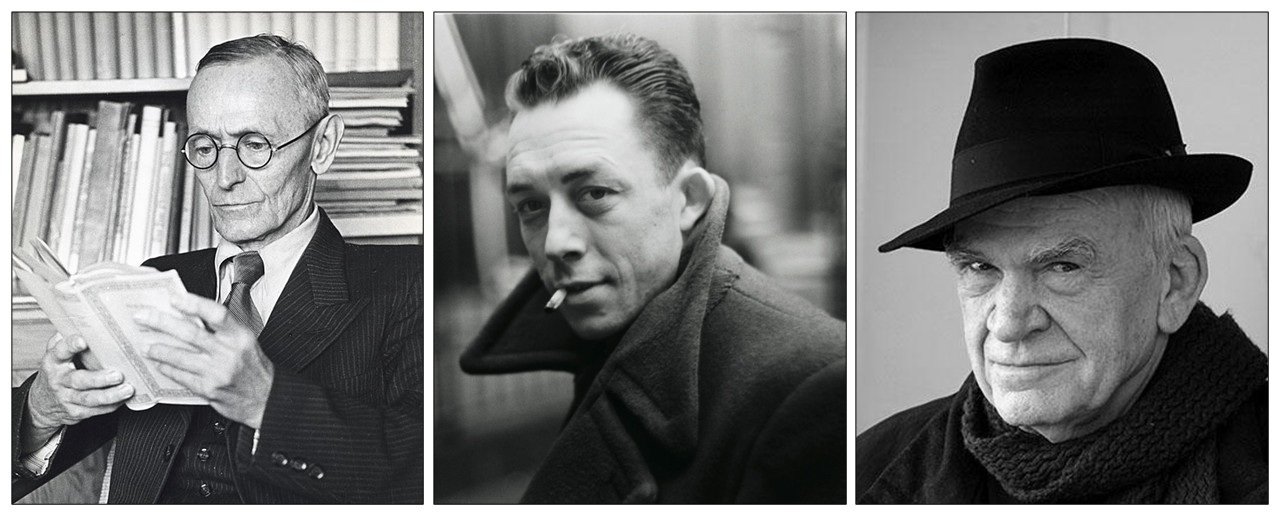
From left: Hermann Hesse (1877-1962), Albert Camus (1913-60), and Milan Kundera (1929-2023).
That experience left me with a persistent question: If our behavior changes so much depending on context, which version of us feels most authentic, and how do we come to experience something as truly our own? For a long time, I looked for answers in books. Reading Hermann Hesse, Albert Camus, Milan Kundera, and other writers, I tried to understand myself by comparing my own experiences with the lives of their characters. Those readings gave me a way to think about who I was, but they also left me wanting something more concrete.
When I began studying psychology, I realized these questions were not only philosophical but also empirical. Later, while exploring graduate programs, I encountered research on the true self and authenticity, including Professor Jinhyung Kim’s work. I felt that the questions I had been circling for years had finally found a research home. I have been following those questions ever since.
ISSEP: You’ve been doing some great research in existential psychology lately. Can you tell us more about your work?
Kyungmin Nam: My research examines how agency influences judgments of the true self. The central question is whether an autonomous negative change can be perceived as more authentic than a positive change that's externally imposed. What we found is that people care about not just what someone chose but how they chose. I presented this work at SPSP 2024.
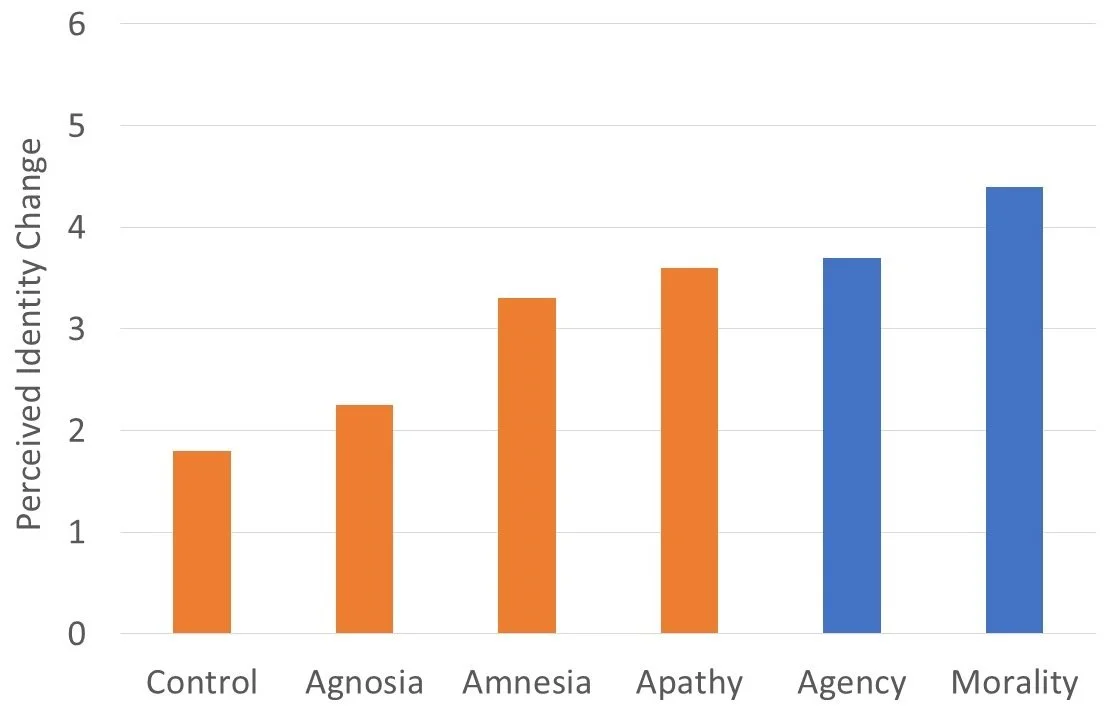
Figure 1. Morality and agency were judged as having the greatest perceived impact on identity change.
To start, we wanted to confirm whether agency is central to identity. We replicated Strohminger and Nichols (2014), who showed that losing moral capacity after brain surgery causes the greatest perceived identity change. We added a sixth condition, losing agency, defined as the sense of control over one's actions and authorship of one's decisions. Results confirmed that losing morality still had the strongest effect. However, losing agency came second (Figure 1), significantly stronger than losing memory or other cognitive abilities. This suggested agency plays a distinct role in identity.
Building on this, we tested how agency and outcome valence interact in true self judgments in real-life contexts. We created scenarios about “Daniel”, a college student making a career decision. In the autonomous condition, Daniel chose to become a musician despite his parents' opposition. In the non-autonomous condition, parental pressure forced him to become a doctor. After this decision, Daniel's personality changed, becoming either more patient and calm, or more impatient and cold. Three patterns emerged (Figure 2). First, positive personality changes were judged as more reflective of the true self than negative changes. Second, autonomous changes were judged as more authentic than non-autonomous changes. Third, there was a significant interaction: autonomous negative changes were judged as more reflective of the true self than non-autonomous positive changes.
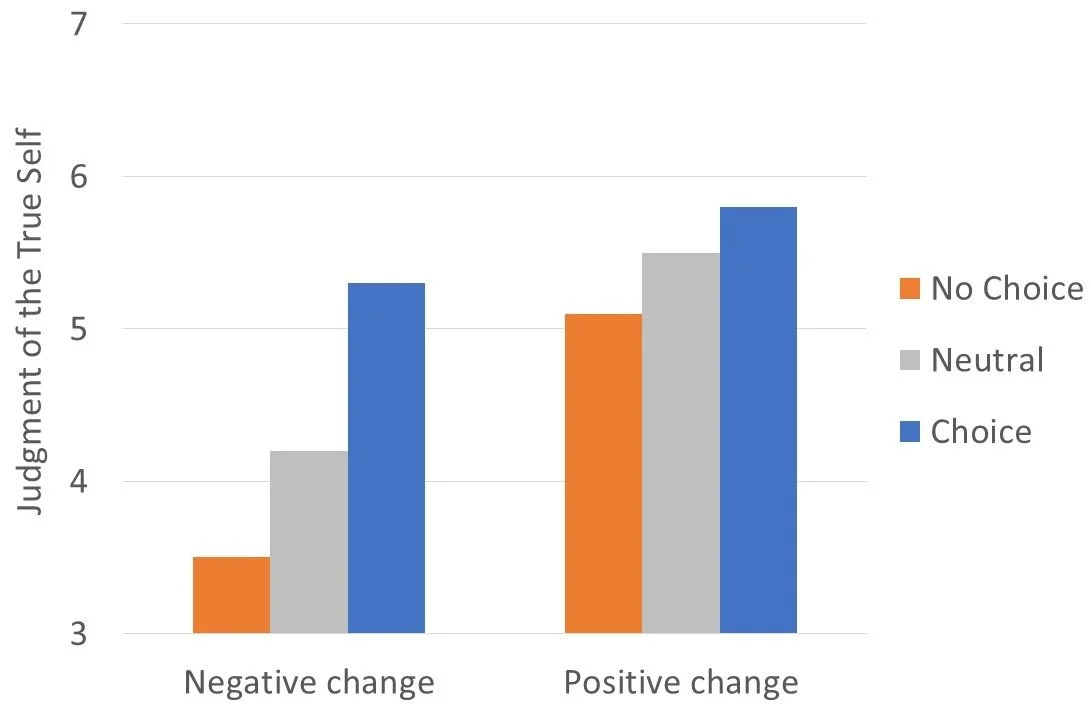
To examine this further, we added a neutral condition where Daniel became a doctor without conflict, simply going along with expectations. The results confirmed the pattern. The choice condition received the highest true self judgments, the neutral condition was moderate, and the no choice condition was lowest. The interaction also showed that in the choice condition, the gap between positive and negative changes was smallest, meaning autonomy reduced the positivity bias. These findings suggest that our conception of the true self isn't only about goodness. We see others as most genuinely themselves when they are the authors of their own lives, even when the story they're writing includes difficult chapters.
ISSEP: Fascinating! How did you develop your interests in that topic area?
Kyungmin Nam: I think this question came from both personal experience and a gap I noticed in the literature. Most of us have had moments where things were going well, but it didn't quite feel like ours. You end up somewhere that looks successful on the outside, but the choices were never really yours. I saw that around me a lot. People who were doing well but felt lost because they had been following someone else's expectations rather than their own. And I noticed an asymmetry in how we talk about life changes. When someone leaves a secure career to pursue something risky, we tend to say they're being true to themselves, even if things don't go well. But when someone passively ends up with a good outcome, we rarely say the same thing.

We constantly make choices in life, to either stay in our comfort zone or take risks. When someone leaves a secure career to pursue something risky, we tend to say they're being true to themselves, even if things don't go well. But when someone passively ends up with a good outcome, we rarely say the same thing.
When I looked at the existing literature, most work focused on the outcomes of change, whether changes were positive or negative, but less attention had been given to what causes the change, whether someone chose it or not. Strohminger and Nichols (2014) demonstrated that moral traits matter most for identity. Newman and colleagues (2014) found that people believe the true self is inherently good. Bench and colleagues (2015) showed that positive changes are seen as discoveries of the true self, while negative changes are treated as departures from it. But that felt strange to me. We fail all the time. We make choices that lead to difficult outcomes. Are those not part of who we really are?
There were theoretical hints that agency should matter. Self-Determination Theory identifies autonomy as a basic psychological need tied to authenticity. Research on self-authorship and free will beliefs points in the same direction. Previous research, showing that impulsive actions are judged as more authentic than controlled ones, also suggests that people associate the true self with something internally driven rather than externally managed (Garrison et al., 2023). But no one had directly tested whether agency could shift true self judgments, especially when outcomes are negative. That was what I wanted to find out—if how we choose matters more than what we choose when people judge who we truly are.
ISSEP: In what ways can your research help us make sense of important human experiences, better understand important events, or inform our cultural or technological trends?
Kyungmin Nam: We judge other people's true selves more often than we realize. Who someone really is, whether they're being authentic, whether a change in them is genuine or superficial. These are not just abstract questions. They shape how we form relationships, who we trust, and sometimes even decisions like hiring or voting that carry real consequences. Yet we rarely stop to ask what we're actually basing those judgments on.
My research suggests that people rely on two things. One is the outcome of a change. Positive changes are consistently seen as closer to the true self, which means people carry a deep intuition that human nature is fundamentally good. The other is agency. When someone actively chose their path, that choice is seen as more reflective of who they truly are, even when it leads to a negative outcome. These two beliefs coexist. We want to see others as good, and we also want to see them as the authors of their own lives.
I think that coexistence says something meaningful about us. Even in a world full of conflict and division, people have not given up on the idea that others are fundamentally good. And at the same time, we hold each other accountable for our choices. We expect that the most important decisions in life should be truly ours. There is something both hopeful and demanding in that. We believe in each other's goodness, but we also believe that being who you truly are requires the courage to choose for yourself.
“I wanted only to try to live in accord with the promptings which came from my true self. Why was that so very difficult?”
ISSEP: Do you see your research topic when you look at arts and culture—does it show up in any music, dance, theatre, film/television, photography, paintings, sculptures, poetry, novels, etc.?
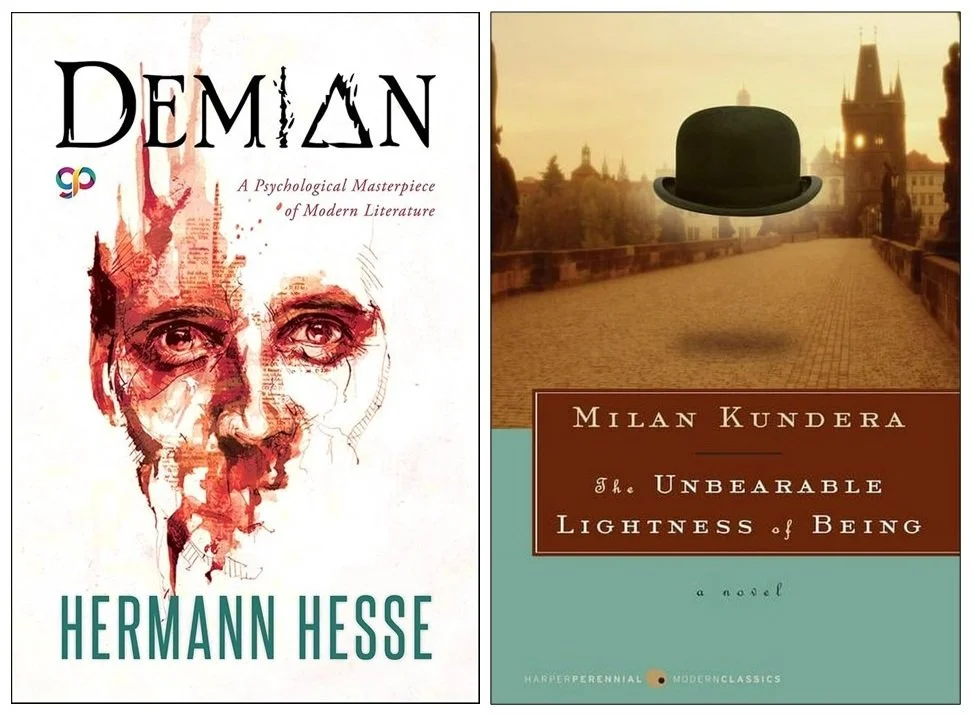
Kyungmin Nam: I often thought of Hermann Hesse's Demian (1919) while working on this research. In Demian, the narrator Emil Sinclair grows up in a home where everything is clearly divided into good and bad. He is expected to stay on the right side. But he wanders, gets lost, and gradually finds his own way. That process is messy and uncomfortable. Yet it is through those moments, not the safe ones, that he comes closer to himself. "I wanted only to try to live in accord with the promptings which came from my true self. Why was that so very difficult?" That line has stayed with me for a long time. I think most of us have felt that at some point.
At the same time, I find myself drawn to Milan Kundera's The Unbearable Lightness of Being (1984). We only live once, so there is no way to know whether our choices were right. Maybe what matters is not finding the good or correct path but accepting the choices we made, even the ones that did not go as planned. I don't have an answer yet. I'll keep living and keep researching.
ISSEP: What do you think are some of the remaining issues for this research topic, and what do you see as the most important next steps toward better understanding these experiences?
Kyungmin Nam: There are a few directions I want to explore. First, agency in my studies was mostly manipulated as a binary, choice versus no choice. But in real life, the degree of agency is more nuanced. I'd like to examine different levels of agency more precisely to understand what it takes for a choice to feel truly autonomous.
Second, my current work focuses on career decisions, but agency matters across many areas of life. Marriage, divorce, religious belief, migration. I'm curious whether the same patterns hold in those contexts.

Third, I'm increasingly interested in how the direction and difficulty of change affect true self judgments. Positive change is often much harder than negative change, and people seem to recognize that. A small positive shift might carry more weight than a large negative one, depending on where someone started. I think there may be something like a reference point that shapes how we evaluate whether a change reflects someone's true self. That's something I'd like to investigate further.
ISSEP: You’ve attended, and presented research at, our Existential Psychology Pre-conferences. How has your experience been with that, and/or what was your favorite part of the event?
Kyungmin Nam: It meant so much to me. It was my first time attending the pre-conference. Much of the research process had been quite solitary for me, long hours sitting with the same questions on my own. So, walking into a room where people from all over the world shared similar interests was something I was not used to.
I was quite nervous during my presentation. I can't remember much of it, to be honest. But what I do remember are the conversations that happened after. When people came up and asked questions or showed genuine interest in my work, I got really excited. Those moments reminded me why I wanted to do this work in the first place. And my favorite part is something that's hard to describe—it's the energy you leave with. Long after the event ends, the inspiration and motivation stay. I still carry that with me.
ISSEP: What is one piece of advice you would give to future students who have an interest in following in your footsteps, so they too can make innovative contributions to the science of existential psychology?
Kyungmin Nam: Existential questions are broad and fascinating, and turning them into research requires the courage to narrow them down. That was one of the hardest parts. Starting with a question that feels enormous and making it testable without losing what made it meaningful in the first place. Learning the methods to examine those questions takes patience too.
Finding the balance between depth and rigor is not easy, but that challenge is exactly what makes this field worth pursuing. In those moments when nothing seems to work or progress feels slow, what helped was not trying to solve everything at once, but simply sitting down and doing a little more. Not everything. Just a little more. Over time, those small efforts accumulate into the kind of work someone once only hoped they might be able to do.
ISSEP: Can you tell us a little about yourself outside the work/research context?





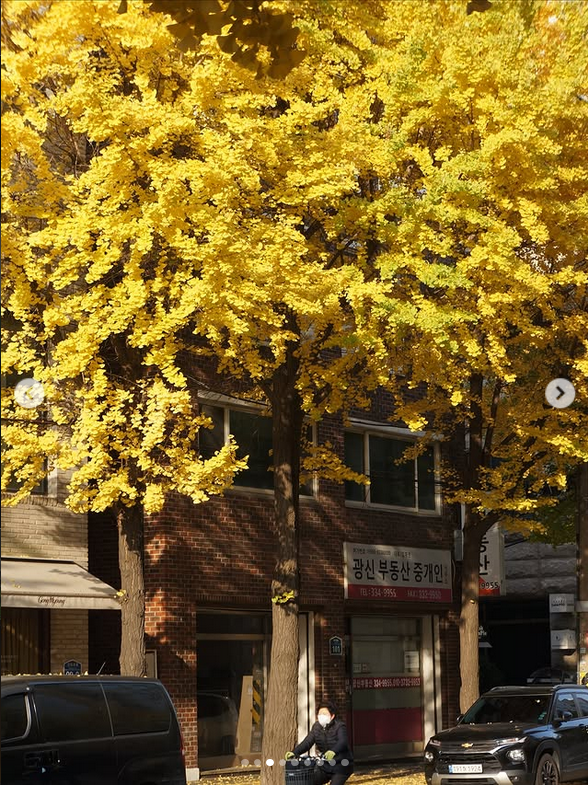





Kyungmin Nam: I have a deep love for coffee. I worked as a barista for quite some time and even ran my own cafe at one point. Brewing by hand, taking in the aroma, tasting, meeting people face to face. It's a different kind of joy from research, and I still enjoy it.
For me, coffee is more than just a drink. I enjoy discovering unique places with personality. There are certain cafes where you can really sense the barista's character, whether through their brewing style, menu choices, the design of the space, or even the music they play. Those places make me curious about the people behind them. Whenever I have time, I like exploring new cafe spots, and even when I travel, searching for great cafes is one of the first things I do. I actually do a lot of my research work at cafes too.
There are so many places I'd love to recommend, but the ones I visit most are Claude Coffee near my school (Seoul, Korea), which makes the best flat white. If I can make one more recommendation, there's Hwandae Coffee Walk. "Hwandae" means hospitality in Korean, and I take people I like there often. The coffee is great; the brunch is great; and just like the name suggests, the owner will welcome you warmly.
ISSEP: A lot of us like to listen to music while working/studying, and in general. What are you listening to lately (during studying, and in general), and what would be your top track to share with others?
Kyungmin Nam: Music is a huge part of my life. I played the violin for over ten years, and I still rely on music to shape my focus and energy.
When it comes to working, I prefer instrumental music with no lyrics. They distract my thinking in any language. Well, maybe a language I don't understand would be fine. I like a steady rhythm, something I can stay with without breaking my flow.
These days, I often listen to Peggy Gou. She's a house music DJ, and my favorite track is Starry Night. I also listen to Nujabes a lot, and random house mixes on YouTube. Sometimes it's hard to get started, but when I put on the right music, I can ease into it naturally.