
Rebecca Ward on self-essentialism, life narratives, and meaning

Rebecca Ward is a fifth year PhD Candidate at Texas A&M University working on existential psychology with Dr. Rebecca Schlegel. She earned her B.S. in Psychology with honors and a minor in Women and Gender Studies from Texas A&M University in 2021 while working in the Existential Psychology Collaboratory. Rebecca is broadly interested in the self and identity. She has also explored other topics including STEM identity in school-aged children as well as the impacts of guided meditation. Her primary research examines self-essentialism, particularly in the way self-essentialism narratives about choice impact meaning. She and her co-author, Dr. Rebecca Schlegel, were a recipient of an ISSEP research grant to extend this work. Pending her intended May 2026 graduation, she plans to seek employment opportunities in the industry. Outside the lab, Rebecca enjoys reading and spending time in nature.
Rebecca on the web: Lab Page | LinkedIn | Google Scholar
By Daryl Van Tongeren, Hope College. March 4, 2026.
ISSEP: How did you first become aware of and interested in existentialism and the science of existential psychology?
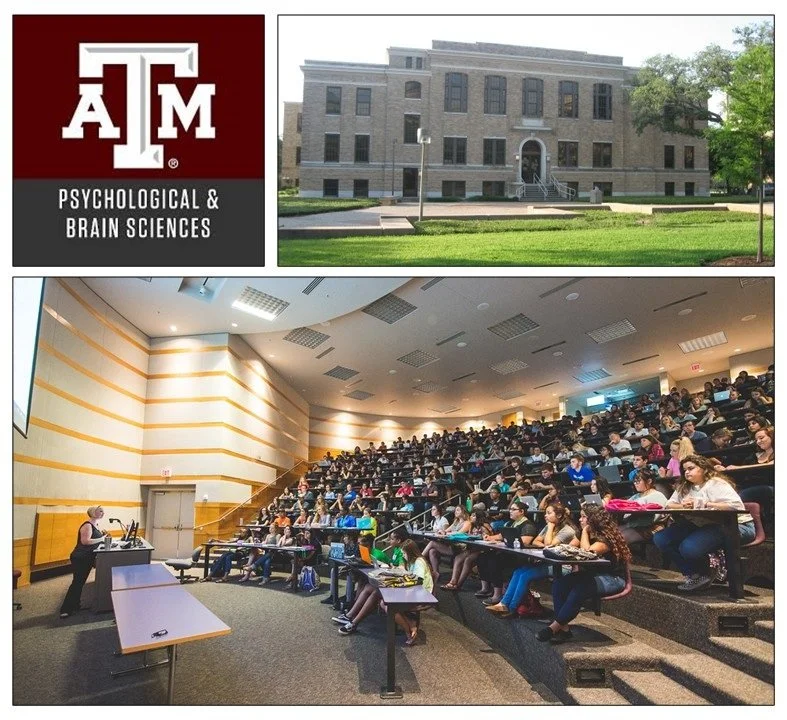
Texas A&M University Psychology Building and classroom lecture experience.
Rebecca Ward: When I was growing up, I always wanted to be a psychologist. Since I was young, I really want to understand what makes people not just make the choices that they do or what makes them tick, but rather tackle bigger questions, such as “Why do we feel emotions?” I'm eight years old asking these questions, so by the time that I got into high school, my high school only offered AP Psychology, and I was waiting my whole life to take that course. I really thought I was going to go into psychiatry and earn my MD, but then I really fell in love with the social psychology unit of AP psychology. It just had something about it that clicked for me, particularly humanistic psychology. That's really what just got me absolutely hooked into it. So much of psychology is focused on the negative of the human experience, and what I really liked about social psychology was this integration of community around you and relating to the individual; and on the humanistic side, it was much more positive, focusing on the potential of being alive and being human.
My very first class I attended was a Monday morning, 9:10am, Introduction to Psychology class. I walk in the class, sit down, and who walks in but Dr. Becca Schlegel. She's my instructor for the class. I would have never known this, but she ended up becoming my chair for my Ph.D.. So, it was one of those moments where you pause—I don't know if the universe works in strange ways, but these kind of moments make you think: coincidence is too weak and fate might be too strong, but either way, it shaped my future.
Her whole class was not focused on existentialism, obviously, but she integrated part of her research and dropped breadcrumbs of the topic throughout, and then she did a call at the end of the semester to recruit research assistants for her lab. So, I applied, got in, and went from there. I worked as a research assistant in her lab for the three years of my undergraduate degree.
ISSEP: You’ve been doing some great research in existential psychology lately. Can you tell us more about your work?
Rebecca Ward: I think for so many people, you really hope that you click with your advisor for graduate school. And I was really fortunate that Becca and I had a really good rapport, even as an undergraduate. I was her lab manager my senior year, and we got to know each other more in that kind of capacity, so it was just a really nice transition to graduate school. My research focuses on self-essentialism and meaning in the context of decision-making. My work is situated in how somebody tells a story about a choice that they make and then predicting their level of meaning based off of the degree of self-essentialism that they're expressing in their narrative.

Self-essentialism is based on the broader construct of psychological essentialism, which says that any group of things has a particular essence that makes it a distinct group from something else. So applied to self-essentialism, it would be that every single individual has a unique essence that makes them different from somebody else. It offers a roadmap to your observable traits, behaviors, and characteristics. Belief in self-essentialism is predictive of well-being. We’re expanding on this literature by capturing this relationship in a novel way. While previous research has done this via self-report and experimental manipulation, we’re capturing this through spontaneous, unprompted expression.
We predicted that the degree of self-essentialism expression that is present in a particular narrative would correlate to how much meaning somebody will derive from the choice. We have asked college student participants to write a couple paragraphs on what major they chose to study. For example, if they indicated that they chose to become a psychology major, because “they’re a people person”, that would be a narrative high in self-essentialism. In turn, our results suggest they would report greater meaning experienced with their choice.
ISSEP: Fascinating! How did you develop your interests in self-essentialism?
Rebecca Ward: I always liked the concept of the self, particularly when I was in undergrad. It was always a quandary to me, that you could be both an actor and the subject of a situation at the same time, Even as I’m talking with someone, I have a voice inside my own head simultaneously talking to myself. Learning about potential selves—such as the ought self, ideal self, and actual self—clicked for me. It is so interesting that we are somehow compartmentalizing all these different facets of ourselves. Our belief in these different features or aspects of ourselves has important downstream consequences; it matters.
Interestingly, I got into this particular area because I was handed a project that someone else couldn’t finish, and almost instantly I was hooked. I loved trying to solve this big puzzle that would make a clear map of how all of these variables were interrelated. We wanted to advance the research linking self-essentialism and well-being, and what I'm doing in my dissertation is breaking new ground. We’ve been developing a new methodology of trying to pull from narrative psychology to develop a coding system to detect self-essentialism as a theme in people’s own stories. We ask people to write an essay about a decision that they've made, and we're able to observe a natural phenomenon of people using their self-essence to justify their choice without any prompting. We’ve had a lot of success with developing the essentials of a codebook. I think the primary contribution will be highlighting how people may be employing self-essentialism to generate meaning in their lives. We know having meaning is important, and that the self can be a source of meaning, so understanding that this is potentially one way people create it adds to our understanding.
ISSEP: In what ways can your research help us make sense of important human experiences, better understand important events, or inform our cultural or technological trends?
Rebecca Ward: This work reinforces and highlights that the way that someone thinks about and remembers events in life really matters. The fundamental question is this: is there a true essence existing inside of us? We don't really know, right? But as our work focuses on the perception someone holds, if you feel like your self-essence guided your choice, then we see these positive associations for you.

When people believe they are imbued with essential characteristics, and view that essence as driving their actions, they tend to experience a sense of meaning in life.
Why does this work matter? Looking at one direction of these results, it shows that it's important to think about how we tell ourselves and other people the stories of our lives. Most people do this every day without thinking. It happens automatically, unconsciously. If you ask someone why they made a really big, important life decision, they don’t necessarily consciously think about and point to the idea that they have this deeply rooted part of who they are that wants them to do this thing. But when you ask people to share their justification, you see this self-essentialism theme coming through. People rely on this lay theory (follow your true self), day to day, to make these kinds of big decisions. That knowledge helps us understand how we live our lives and what benefits we could reap.
For example, when choosing a major, someone might justify by saying, “Oh, I have always been a people person, and I've been able to connect with others for a long time, and I really have this drive to make the world a better place. So, for that reason, I've decided to study nursing.” That's really in stark contrast to those who might explain, “I’ve always wanted to live in a really nice home, and I want a particular lifestyle, and so for that reason, and because I'm not bad at math, I’m going into engineering.” People might not use the language of self-essentialism, but it comes through in how they make, and justify, their decisions. Risking some ironic self-disclosure, self-essentialism is largely why I got into studying psychology: I always saw myself as a psychologist!
ISSEP: Do you see these topics when you look at the arts and humanities?
Rebecca Ward: There are countless movies and books written with the general plot line that a character in the beginning of their story is living where they're not happy and they're basically inauthentic to who they truly are. And then at some point in crux of the story, they make a decision to set out on an adventure, and they live their most authentic life at that point. They express their truest form, and then by the end of the story, they're happy. This is a very classic narrative.
A perfect example of this is Elsa from the Frozen franchise, and specifically from Frozen 2. I think Elsa's entire story is basically a deconstruction and almost an anthropomorphized representation of the belief of true self, or self-essence. And so, for those who are not caught up on the Frozen franchise, in the beginning, she's living in her town as a Queen. Still, she is somewhat dissatisfied. She follows a voice, a literal voice, that is calling out loud to her to seek her true self. She follows that voice throughout the movie, and that she eventually finds her true self. From there, she decides to live authentically and carry out the rest of her life in the forest where she truly belongs. She doesn't put that fine of a point on it at the end, but when the story concludes, you can clearly tell she's very satisfied and happy with her choice, and so she's better off from when she started, because she followed her essence.
We also see this in how people view their life as a story. They say things like “That chapter of my life was really fulfilling,” or “That chapter was a turning point.” Other people say, “Just do it for the plot!” or “Bring that main character energy!” We are all situating ourselves to be our own autobiography, and our stories are being written every single day. Our language is saturated with self-essentialism, where life is a story, and we're both the authors of it and the main characters.
ISSEP: What do you think are some important next steps toward better understanding these experiences?
Rebecca Ward: The next thing that we wanted to look at is the different contexts where this phenomenon of self-essentialism theme may be related to meaning. We have been able to extend this work to career choices and other major social choices that people make.

We have a study in the works currently that is looking at manipulating self-essentialism versus a control and then introducing threat to see how people respond. We’re predicting that people who experience the essentialist framing will report higher meaning, even when threat is introduced. Self-essentialism would provide a buffer because of the downstream sense of meaning that it offers. If your decision is based on who you are, deep down, that sense of meaningful purpose might be difficult to shake—even when a threat is present.
ISSEP: You have presented at the ISSEP Preconference. How was that experience?
Rebecca Ward: I was able to present and attend the when the conference was virtual. I would say my favorite thing was getting to see the diversity that of the work that is going on in existential psychology. It was wonderful to see a showcase of different work all in one centralized place. It’s also really nice to feel a sense of community that is different than just your university or just your lab, or even your group of consistent collaborators. It is also fun because the preconference seems to keep expanding, and has different connections with other disciplines that add a new flavor.
ISSEP: What's one piece of advice you would give to future students who have an interest in following in your footsteps so they can make innovative contributions to the science of existential psychology like you have?
Rebecca Ward: I think the biggest piece of advice would be to begin experimenting (pun intended!). Start trying different research experiences as soon as you can. I did independent studies, and I did shadowing programs, even back in high school. And though they weren't situated in existential psychology, every single mentoring experience that I got to be a part of really has shaped me into being the researcher that I am and how I think about this process. It also helps you hone your technical skills and transferable skills. Communicating and collaboration are important across the board, no matter what you go on to do. By experimenting, you can also learn what you do like and what you don't like, so you can make the right decision for yourself when the time comes for whatever the next step for you is.
ISSEP: Can you tell us a little about yourself outside of the work or research context?
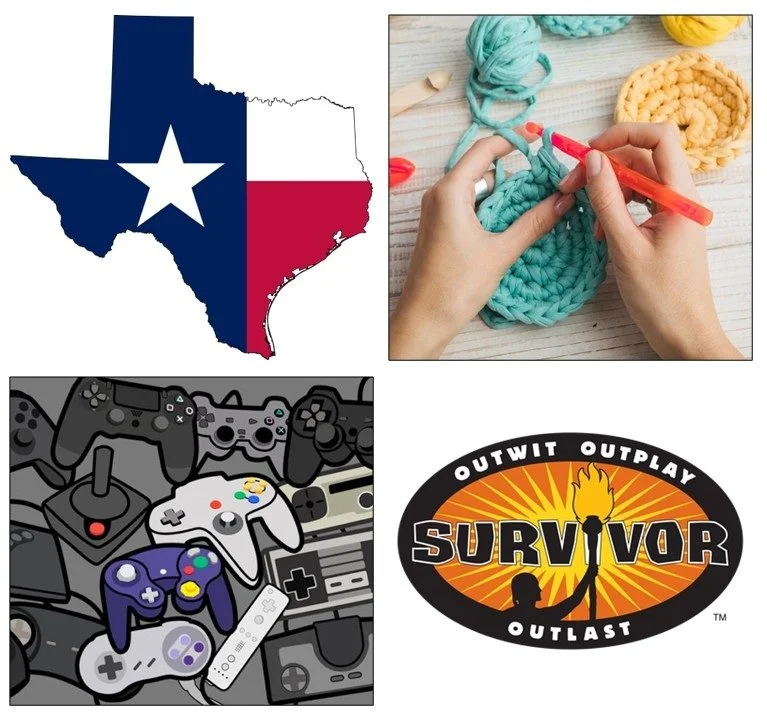
Rebecca Ward: I am a native Texan, so I grew up saying “y'all” and I wear cowgirl boots all the time. Unironically, those have always been in fashion in Texas. Everybody else just finally got with the trend. Unfortunately, though, I do not ride a horse everywhere I go, which is an actual question that I have gotten before, asked by people not from Texas.
In terms of hobbies. I really love the TV show Survivor (2000-present), that's been airing on CBS for years and years. As far back as I literally can remember, I remember watching survivor every single week with my parents and still do. It is the best social experiment ever. Big, big fan.
I also like to play video games, spend time with loved ones, of course, and I've recently taught myself how to crochet, which has been a lot of fun.
ISSEP: A lot of us like to listen to music while working or otherwise, what are you listening to lately?
Rebecca Ward: When I'm working, it's piano music that's usually on the background. I am not picky: just some calming or soothing background noise.
In terms of music outside my work day, I think a true music critic would probably cringe at the disaster that is my playlist, because one minute it goes from the most recent country music song to a belting performance from a Broadway artist, and then back to country music. Right now, it leans country. My top song on repeat is called A Day Late and a Buck Short by Julia Cole. She's a big up-and-coming country music artist right now. I really like her stuff. And it kind of reminds me of Carrie Underwood's Before He Cheats, which is a good pump-up song.