
Belief in Free Will: An Existential Psychological Dynamic
By Elizabeth Seto, Colby College. March 1, 2026.

Imagine that your alarm goes off in the morning. Do you get up immediately, or do you hit snooze for another 10 minutes? Here’s another situation. You just got off work and feel a little hungry. Do you cook the healthy meal you prepared at home, or do you order take-out from your favorite restaurant? Consider one more example. The cashier at the grocery store does not realize that they did not ring up one of your items. Do you inform them of their mistake, or do you pretend you did not notice this error? These are simple examples of everyday choices that quietly invoke your sense of free will.
The psychological belief in free will
While free will may seem like a commonplace term in today’s society, this concept dates back to the nineteenth and early twentieth centuries where existential philosophers such as Kierkegaard (1844/1981), Sartre (1943/1974), and Nietzsche (1886/2003) helped turn free will into one of the greatest questions about human existence. “Does free will exist?” This is a question that has been debated over and over again.
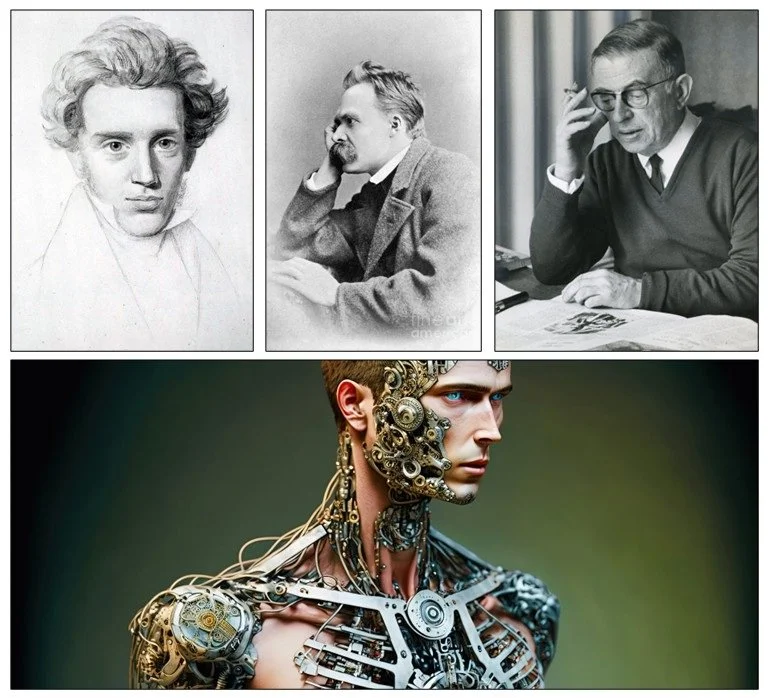
Philosophy often addresses the question of whether humans have free will or are subject to determinism (see Alfred Mele’s 2023 ISSEP Feature article on free will). Top row: Kierkegaard, Nietzsche, and Sartre.
Centuries later, psychologists took a different approach to understanding free will. While some scholars continued to question the existence of free will, arguing that it is incompatible with brain processes (Libet et al., 1983) or merely an illusion created by the brain and mind (Wegner, 2004), psychologists increasingly began to ask a different question. Rather than debating whether free will exists, some have shifted their focus to whether variation in belief in free will has meaningful psychological consequences (Baumeister & Brewer, 2012). Research has shown how belief in free will plays a role in social behaviors such as conformity (Alquist et al., 2013), across different aspects of subjective well-being like meaning in life (Crescioni et al., 2016), and even in judgments about physical health including stigma surrounding substance use (Ozkok et al., 2022). Thus, almost two decades of psychological research suggest that belief in free will is a worthwhile object of scientific inquiry, offering concrete insights into human thought, feeling, and behavior.
Free will is notoriously difficult to define, a point attested to by centuries of philosophical work on the topic. As a general principle of scientific inquiry, before a concept can be meaningfully studied or manipulated, it must first be carefully defined. Accordingly, our academic relatives in philosophy have spent considerable time clarifying what free will means (see Alfred Mele’s 2023 ISSEP Feature article on free will). Although free will is often framed as a complex, metaphysical concept in contrast to determinism, it is generally understood by ordinary people as the ability to make choices and determine outcomes free from constraints (Baumeister & Brewer, 2012). When people describe moments in their own lives when they felt free, they emphasize acting with deliberation and conscious intent, achieving goals, and behaving morally (Stillman et al., 2011). Taken together, this work suggests that free will can be understood not only as a philosophical abstraction, but also as a psychologically meaningful belief grounded in everyday experience, opening the door for systematic scientific investigation.
Initial research on belief in free will
Research on individual differences in belief in free will has revealed that people differ substantially in how much control they believe they have over their own actions, and that where people fall along this spectrum predicts how they think, feel, and behave in everyday life (Baumeister & Brewer, 2012). At the same time, I have found that experimentally manipulating belief in free will has been especially informative for understanding this construct. The first empirical article to manipulate belief in free will, and to inspire a wave of subsequent research, came from Vohs and Schooler (2008). Across two experiments, they found that reducing belief in free will led to greater dishonesty and cheating behavior.
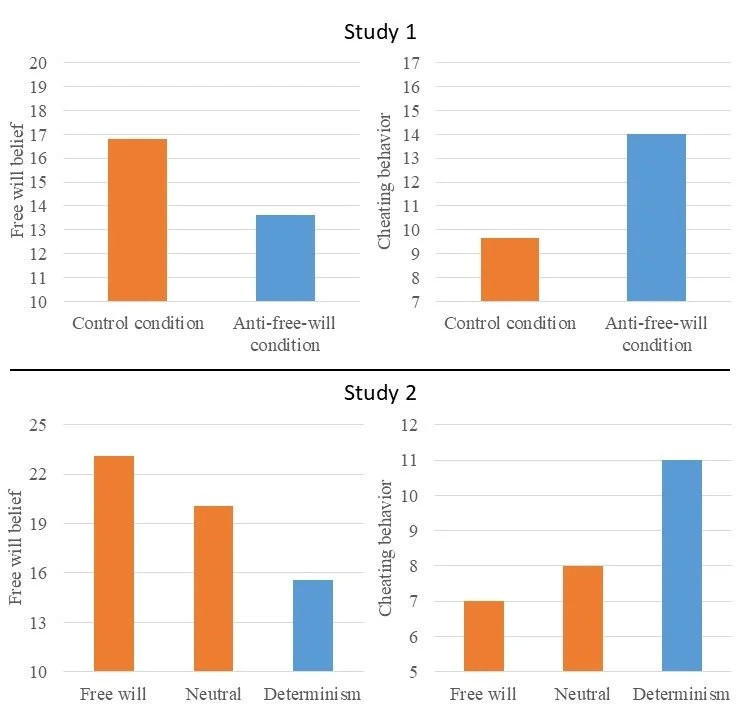
Data from Vohs and Schooler (2008) which found that reading about determinism undermined participants’ belief in free will and undermined morally responsible self-regulation—indicated by greater cheating on academic (Study 1) and financial (Study 2) outcomes.
In their first experiment, participants were randomly assigned to an anti-free-will condition, in which they read a passage from The Astonishing Hypothesis by Francis Crick (1994) illustrating that free will is an illusion or to a control condition, in which they read a passage about consciousness that did not refer to free will. In their second experiment, Vohs and Schooler (2008) adopted a procedure originally developed by Velten (1968), in which participants reflected on a series of statements designed to induce belief in free will, determinism, or a neutral mindset. Participants in the free will condition reflected on statements emphasizing personal choice and agency (e.g., “I am able to override the genetic and environmental factors that sometimes influence my behavior”) whereas participants in the determinism condition reflected on statements emphasizing genetic and environmental causation (e.g., “Ultimately, we are biological computers – designed by evolution, built through genetics, and programmed by the environment”). A neutral condition included statements unrelated to free will (e.g., “Sugar cane and sugar beets are grown in 112 countries”).
Across both experiments, these manipulations reliably shifted belief in free will. More importantly, participants exposed to deterministic messages engaged in more cheating than those in the control condition in the first experiment, and more cheating than those in both the free will and neutral conditions in the second experiment. Notably, this pattern aligns closely with lay conceptions of free will identified in autobiographical narrative work. When people experience free will, they emphasize moral behavior and personal responsibility (Stillman et al., 2011). Consistent with this view, reducing belief in free will in these experiments was associated with increased cheating.
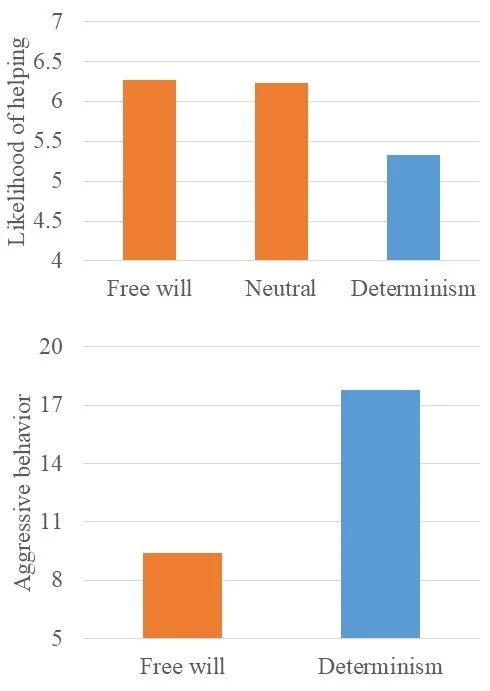
Data from Baumeister, Masicampo, and DeWall (2009) found that undermining belief in free will (by reading arguments for determinism) led to reduced likelihood of helping (Study 1; upper panel) and increased aggression (Study 3; lower panel).
A year later, Baumeister, Masicampo, and DeWall (2009) extended this work by examining the consequences of free will beliefs for aggression and prosocial behavior. When they measured free will beliefs, they found that people who chronically endorsed weaker beliefs in free will were less helpful toward others. Importantly, the authors then demonstrated that similar patterns emerged when disbelief in free will was experimentally induced. Using the same Velten-style procedure introduced by Vohs and Schooler (2008), they showed that temporarily weakening belief in free will increased aggression and reduced prosocial behavior. In other words, when people experienced lower belief in free will, they were less likely to act in morally constructive ways toward others, again in line with evidence that lay conceptions of free will are closely tied to moral responsibility and ethical behavior (Stillman et al., 2011).
Several years later, Alquist, Ainsworth, and Baumeister (2013) extended this work by examining whether disbelief in free will also increases conformity. Their studies are particularly informative because they relied on a slightly different approach to manipulating free will beliefs. In one manipulation, participants rewrote a series of statements endorsing free will, determinism, or neither, a task designed to encourage active reflection on these ideas. In another manipulation, the authors included an additional condition that posed a broader threat to meaning. In this condition, participants saw statements such as “Sometimes the world seems like a colony of ants, each individual endlessly repeating his behavior until he dies.” This additional control condition allowed the authors to rule out the possibility that conformity simply reflected generalized existential unease rather than reduced belief in free will.
Across experiments, participants exposed to anti-free-will messages showed greater conformity than those in the other conditions. Notably, this pattern aligns with evidence that lay conceptions of free will emphasize acting with deliberation and conscious intent. When belief in free will is weakened, people may be less inclined to rely on their own judgments and more likely to defer to others, consistent with narrative work showing that free will is experienced as deliberate and self-directed (Stillman et al., 2011).
The need for new methods in studying belief in free will
I began investigating the psychological consequences of belief in free will during a period of active and rapid development within existential psychology. Like many psychologists who study belief in free will, I am not concerned with debating the metaphysics of free will. I am much more interested in what happens when we believe in free will and what happens when our belief in free will is diminished, even if the effects are temporary. Early findings that reducing belief in free will influenced important social behaviors such as cheating (Vohs & Schooler, 2008), aggression (Baumeister et al., 2009), and conformity (Alquist et al., 2013) made me wonder what else altering free will beliefs could do.
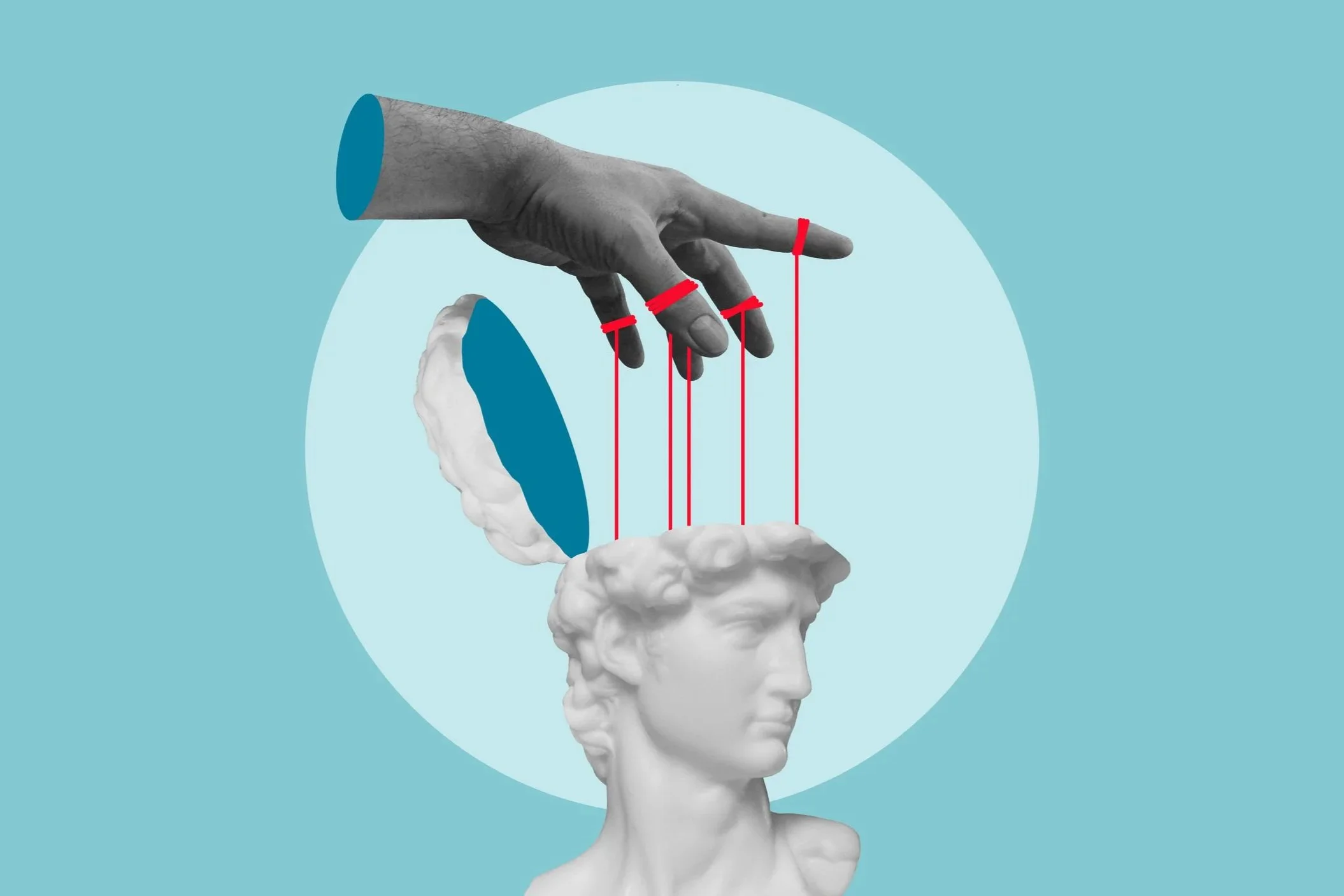
I became particularly interested in whether shifting belief in free will would influence the self and other social judgments, an area that was understudied. While understanding behavior is important, questions about who we are and how we perceive others are central to making sense of a complex world. After all, existential psychology is rooted in learning about the human experience, and knowledge about the self and how we evaluate others is pivotal to expanding this rich field of work.
Before this undertaking, however, I became increasingly uneasy with how belief in free will was being studied experimentally. Much of the existing literature relied on variations of the same manipulation introduced by Vohs and Schooler (2008). While this approach proved influential, heavy reliance on a single paradigm raises familiar concerns about conceptual replication and the robustness of psychological effects, concerns that were becoming increasingly salient as debates about reproducibility in psychological science entered the mainstream.
I was also concerned that many of the existing manipulations relied on relatively passive tasks, such as reading, reflecting on, or rewriting abstract statements about free will for extended periods of time. Although such procedures are effective for inducing belief change, beliefs about free will are deeply tied to people’s lived experiences of choice, agency, and responsibility. As a result, I worried that these tasks might not fully engage participants or resonate with how free will is experienced in everyday life, particularly in more diverse or less naïve samples. Motivated by these apprehensions, I began developing a new belief in free will manipulation designed to complement existing approaches by emphasizing personal experience.
A new experimental manipulation of psychological belief in free will
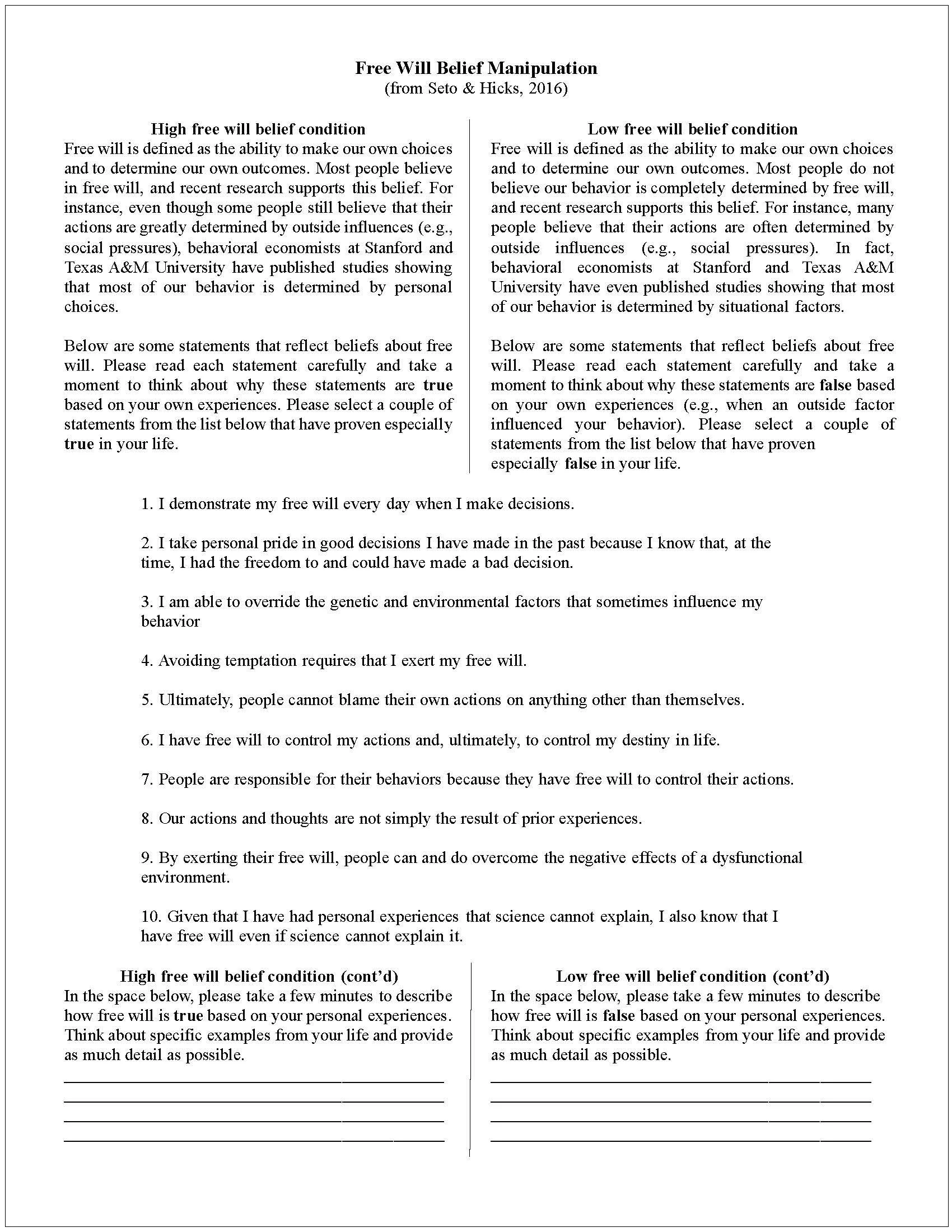
The Free Will Belief Manipulation, developed and validated by Seto and Hicks (2016).
In designing a new free will belief manipulation, there were two primary goals I hoped to achieve. First, rather than contrasting belief in free will with determinism, I wanted to examine differences between relatively high and relatively low belief in free will. This choice was intentional and aimed at keeping interpretations clear, without becoming entangled in philosophical debates about whether belief in free will is compatible with determinism. Second, instead of asking participants to reflect on or rewrite abstract statements, I wanted them to reflect on their own lived experiences with free will. Drawing on classic work on attitude change and persuasion, we know that personally relevant messages are more likely to foster attitude change (Petty & Cacioppo, 1984; Petty, Cacioppo, & Goldman, 1981). I reasoned that asking participants to write about specific instances in which they experienced high or low free will would more directly engage their sense of agency and, in turn, produce stronger and more psychologically meaningful shifts in this belief system.
I first introduced this new belief in free will manipulation in a set of experiments examining whether weakening free will beliefs reduces true self-knowledge (Seto & Hicks, 2016). In that article, the manipulation was presented as a stand-alone pilot designed to test whether reflecting on personal experiences of agency could reliably shift free will beliefs. Participants were randomly assigned to read a brief description about recent research on free will beliefs that emphasized either personal choice (high belief in free will) or situational determination (low belief in free will). Then, they were presented with a list of 10 statements reflecting free will beliefs, drawn from prior work by Vohs and Schooler (2008) and Alquist et al. (2013). In the high belief in free will condition, participants selected 3 statements and described how each statement was true based on their experiences. In the low belief in free will condition, participants selected 3 statements and described how each statement was false based on their experiences. As intended, this manipulation successfully shifted belief in free will: participants in the high belief condition reported stronger free will beliefs than those in the low belief condition. This initial evidence suggested that grounding the manipulation in personal experience provided a viable and effective alternative to existing approaches.
The existential psychological dynamics of belief in free will
I have since used this belief in free will manipulation to examine a range of psychological outcomes. As noted earlier, this free will belief manipulation was first used to test whether weakening belief in free will lowers true self-knowledge (Seto & Hicks, 2016). In the first study, participants completed the free will belief manipulation and then reported on their levels of self-alienation, a subscale of the Authenticity Scale (Wood et al., 2008), and true self-awareness, a subscale of The Authenticity Inventory (Kernis & Goldman, 2006). In a second study, participants completed the same manipulation before a moral decision-making task, after which they reported how authentic they felt while making those decisions.
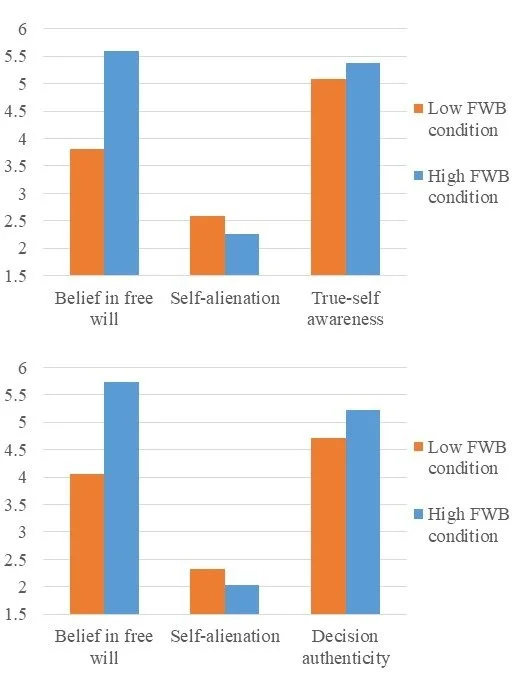
Data from Seto and Hicks (2016) demonstrate that weakened free will belief (FWB) is associated with self-alienation, true-self awareness, and decision authenticity. Upper panel: Study 1. Lower panel: Study 2.
Across both studies, weakening belief in free will led participants to feel more self-alienated, less aware of their true selves, and less authentic during moral decision-making. These findings suggest that belief in free will plays an important role in maintaining a coherent and accessible sense of the self, particularly in contexts that require reflection on values and moral choice. Importantly, this work also helps clarify earlier findings showing that reducing belief in free will increases morally relevant behaviors such as cheating and aggression (Vohs & Schooler, 2008; Baumeister et al., 2009). By directly weakening belief in free will without contrasting it with determinism, these studies suggest that diminished free will beliefs themselves, rather than determinism per se, may undermine moral self-regulation by disrupting people’s connection to their true selves.
Additionally, I have found evidence that belief in free will shapes how people experience time, particularly the future (Seto et al., 2021). We examined the bidirectional relationship between belief in free will and future time perspective, which reflects people’s sense of how much time they have left to pursue their goals (Lang & Carstensen, 2002). In the final study of this work, participants completed the belief in free will manipulation I developed and then described three goals they were currently trying to accomplish. They subsequently reported their perceived future time perspective with respect to these goals. We found that weakening belief in free will led participants to perceive that they had less time available to pursue their goals. We propose that belief in free will functions as an agentic tool, shaping how much future people feel they have and motivating sustained pursuit of meaningful outcomes, in line with evidence that free will is experienced as deliberate, self-directed action in everyday life (Stillman et al., 2011).
Building on this work showing that belief in free will shapes how much future people feel they have to pursue their goals, I have also found evidence that manipulating belief in free will alters how people perceive their social positions and life trajectories (Seto, 2024). For brevity, I will describe the first two studies from this line of research. In Study 1, participants completed the free will belief manipulation I developed and then reported their perceived individual social mobility. In Study 2, participants completed the same free will belief manipulation and then completed the MacArthur Scale of Subjective Socioeconomic Status (Adler et al., 2000) to assess perceived social mobility across four time points. Across both studies, challenging belief in free will reduced subjective perceptions of social mobility such that climbing the socioeconomic ladder felt less feasible. These findings suggest that when belief in free will is weakened, people feel less confident in their ability to shape not only their future goals, but also their broader socioeconomic trajectories.
Free will beliefs matter

Research using experimental manipulations of belief in free will continues to be especially valuable within existential psychology, where questions of agency, meaning, and responsibility are central. Across diverse domains, this work has revealed how deeply free will beliefs shape fundamental aspects of the human experience.
For example, within the subfield of social cognition, focused on understanding how people perceive, interpret, and process information, research has found that bolstering belief in free will leads to more counterfactual thinking (Alquist et al., 2015). As counterfactual thinking reflects how we imagine alternatives to past events, belief in free will may be useful in that it helps us understand our past decision-making and encourages us to think about how we may act better in the future.
Within the study of subjective well-being, research has found that inducing disbelief in free will led to lower meaning in life, and bolstering belief in free will led people to set more meaningful goals (Crescioni et al., 2016). For many, a life without meaning means no life at all. The sense of agency invoked by free will beliefs may help people find and experience meaning in their lives.
Experimental manipulations of free will belief also have been extended to mental and physical health. For instance, participants induced to hold stronger beliefs in free will have been shown to endorse greater substance use stigma compared to those whose belief in free will was weakened (Ozkok et al., 2022). Here, free will beliefs help us understand why different reasons for stigmas emerge. Taken together, this growing body of work highlights a central insight of existential psychology: beliefs about free will are not abstract philosophical positions, but powerful psychological lenses through which people interpret themselves, their choices, and the meaning of their lives.
Are the effects of free will beliefs reliable?

I would be remiss if I did not address the replicability of earlier work manipulating belief in free will, particularly the influential findings reported by Vohs and Schooler (2008). Several researchers have reported difficulties replicating these effects (e.g., Buttrick et al., 2020; Nadelhoffer et al., 2020). A recent large-scale meta-analysis also concluded that belief in free will can be reliably manipulated, but that evidence for consistent downstream behavioral consequences is relatively modest (Genschow et al., 2023). This has led some to question whether the effects of weakening belief in free will have been overstated.
Importantly, however, the same meta-analysis highlights substantial heterogeneity across studies and emphasizes that the effectiveness of free will manipulations depends on how beliefs are operationalized and engaged (Genschow et al., 2023). Many early studies simultaneously reduced belief in free will and increased belief in determinism, making it difficult to isolate which component of belief change drives downstream effects. From this perspective, mixed replication outcomes may reflect methodological variation rather than the absence of psychologically meaningful effects. Rather than negating two decades of research, these findings underscore the importance of refining how belief in free will is manipulated, distinguishing high versus low free will beliefs, and conducting both conceptual and direct replications. Continued work along these lines is essential for clarifying when, how, and for whom beliefs about free will shape thought, feeling, and behavior.
Conclusion
While belief in free will is philosophical at its core, nearly two decades of psychological research suggest that it is also a meaningful and tractable object of scientific study. Understanding how people with strong versus weaker beliefs in free will think, feel, and act offers valuable insight into how humans experience agency, responsibility, and choice in an increasingly complex world.

Elizabeth Seto, Ph.D., is a social psychologist interested in studying a variety of topics historically found in existential philosophy. She received her B.A. in Psychology at Baylor University and her Ph.D. in Social and Personality Psychology at Texas A&M University. She joined the Psychology Department at Colby College in 2017. She is currently pursuing two lines of research. Her first line of research examines the mechanisms and psychological consequences of belief in free will. Specifically, she is interested in how belief (or disbelief) in free will influences different components of our self-concept and our social behavior. Her second line of research focuses on understanding how people experience authenticity. In other words, under what circumstances do we find or feel closer to our true selves?