
The Curious Utility of Supernatural Beliefs

By Steven Heine, University of British Columbia. April 6, 2026.
The study of human psychological universals – those characteristics of ways of thinking that are found in all cultures – is a fascinating but challenging endeavor. Though all humans alive today descend from a rather small group of individuals who lived in Africa about 70,000 years ago, there is a vast amount of diversity that characterizes how people think across cultures of the world. Some seemingly basic phenomena, such as one’s ability to recognize the color blue, to understand the quantity of 5, to remember whether something had happened on one’s right or on one’s left, are perhaps surprisingly NOT universal, in that people in many cultures aren’t able to do this (Heine, 2026).
But across this backdrop of stunning cultural diversity in ways of thinking stands one feature of our minds that has been found in all societies around the world: people maintain supernatural beliefs. In all cultures there are people who are convinced about things which they cannot detect with any of their senses (Brown, 1991). Moreover, these beliefs come to govern many important aspects of people’s lives, such as in court proceedings, medical interventions, and marriages. And people commonly turn to their supernatural beliefs to answer some of the largest questions that they entertain, such as to explain the events that are happening in the world, what will happen after their deaths, or how the world came to be.
Visit the Joseph Campbell Foundation to learn more about Campbell’s work on the power of supernatural myths.
As the mythologist, Joseph Campbell put it, “buried deep in our DNA, no matter who we are, is the need to worship, to believe, and the capacity for reverence.” At root, it seems we are a supernatural species, with some people in all societies concluding that the world around them is constructed on a foundation of mysterious and magical forces.
The Variety of Supernatural Beliefs
Although people in all cultures have some kinds of supernatural beliefs, the particular beliefs themselves vary tremendously across societies. Some believe that witches can cast spells on their enemies, that elves can cause accidents, that people can become zombies after dying, that spirits can inhabit one’s tools, or that an individual’s soul may continue to exist after their death, among countless others. But the fact that people in all societies maintain some version of these nonmaterial beliefs raises the question of how such beliefs became part of a universal human nature.
When a human trait is a cultural universal, it suggests the possibility that the trait may be adaptive in some way. At first glance, the notion that supernatural beliefs may be adaptive seems counterintuitive, as it would seem that an individual who perceives things in the real world accurately would be more likely to thrive than one who puts their trust in supernatural forces that cannot be perceived or even understood. Believing in things that lie outside of our perceptions to confirm, and often making key life decisions on the basis of those beliefs, would seem to pose substantial costs. This suggests that any kinds of adaptive benefits that supernatural beliefs might entail must be substantial enough to outweigh the obvious costs to individuals relying on such beliefs.
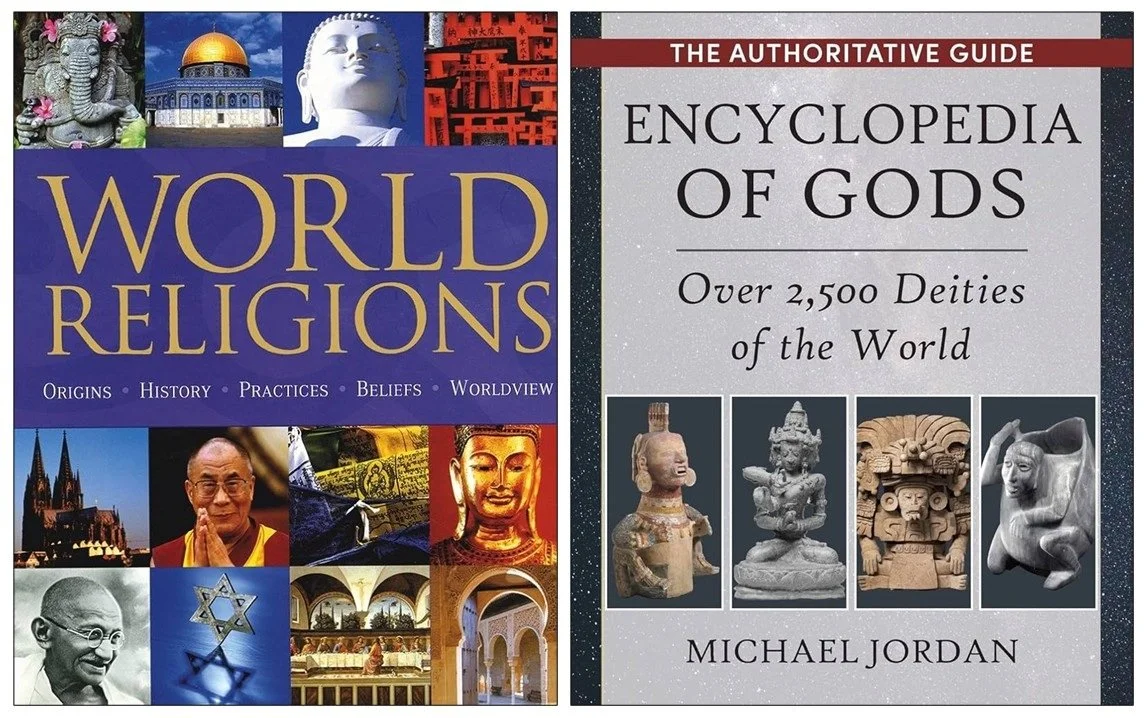
Terhart and Schulze’s World Religions (2007) and Jordan’s classic Encyclopedia of the Gods (2022).
People’s supernatural beliefs are perhaps most evident in terms of their religions, which are organized systems of belief toward supernatural agents. There is no shortage of religions, with some estimates being as high as 10,000 different religions being present across the world, with as many as two new religions emerging each day, showing the strength of people’s impulse to turn to supernatural beliefs (Barrett et al., 2001).
And people’s penchant towards the supernatural beliefs that make up religions appear to serve a variety of key psychological functions. First, supernatural beliefs help to quell people’s anxieties. When people are worried, or struggling, they are more likely to turn to supernatural beliefs to help them to cope with the difficulties in life. Indeed, researchers have been able to predict the degree of commitment to supernatural beliefs in different regions by measuring various indices of suffering (Gray & Wegner, 2010). A second function of supernatural beliefs, especially for religions that entail beliefs in an omniscient moral God (the so-called Big Gods), is to encourage people to act more prosocially, facilitating cooperation with strangers, and allowing people to get along. This relation between a belief in a moral God and prosocial behavior is so reliable that researchers have argued that it enabled humans to form large cooperative societies (Norenzayan et al., 2016). And a third function of supernatural beliefs is to provide a sense that things are under control. People have a strong desire to feel that they are in control of their worlds, and when they perceive that matters are beyond their own ability to control, they are especially likely to believe that supernatural forces are in control of what is unfolding around them (Kay et al., 2008).
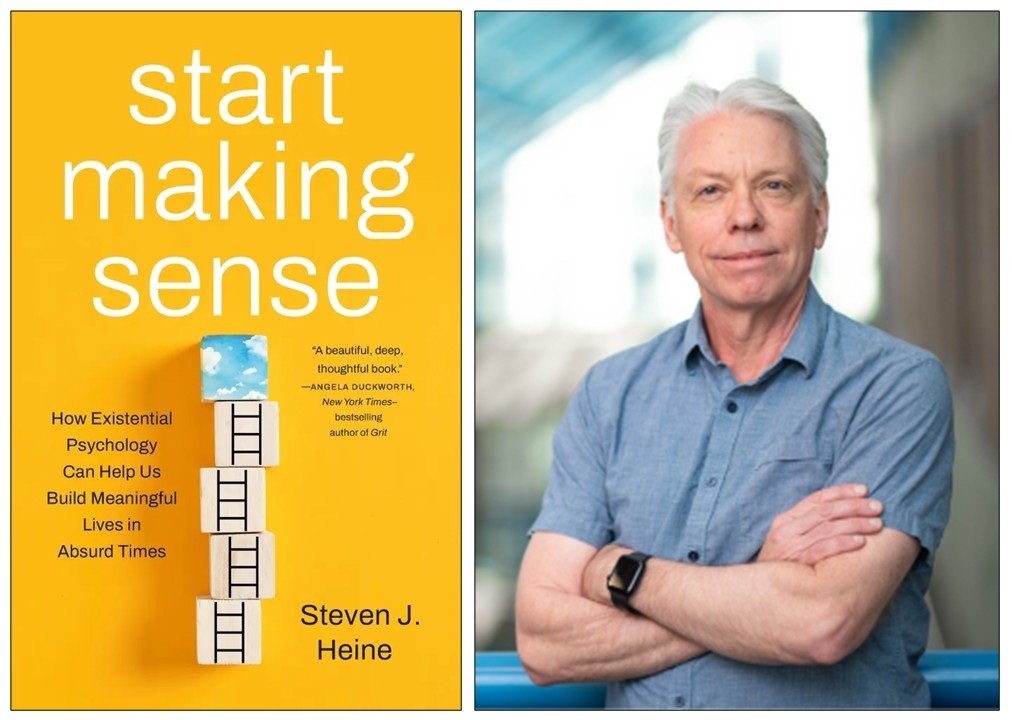
Steven Heine and his book, Start Making Sense (2025).
Each of these proposed functions of supernatural beliefs has received much attention by psychologists. But in a new book, Start Making Sense (Heine, 2025), I argue that our supernatural beliefs also play a key role in serving people’s existential needs, and can contribute to the sense that one’s life is meaningful. How might we understand why our supernatural beliefs are so central to leading a meaningful life?
Meaning is about Connections
I think the key existential role of supernatural beliefs becomes evident when we consider more closely what meaningful lives are to begin with. But what precisely is meaning?
Although people use the word regularly, ironically it can be hard to know exactly what it means. But at root, I argue that meaning is something quite simple. As Roy Baumeister put it, “meaning connects things.” That is, meaning is ultimately about relations between events, entities, and ideas. What something means to us is a reflection of the ideas that we can connect to it. For example, a consideration of “What does your job mean to you?” reveals that its meaning is all of the ideas that you can relate to it. This may include the sense of pride you get when you do your job well, your feelings towards your boss, the promotion that you’re working hard to secure, the lunches that you share with your coworkers, your most dreaded tasks that you have to do, your frustrations with the traffic on your daily commute, the paycheck that you receive, and so on. All of these aspects shape what your job means to you, and if any of these aspects changed in some significant way, so would the meaning of your job.
We connect all of these ideas into large interrelated networks which I call meaning frameworks. We develop these meaning frameworks across our lifetimes, and the particular meaning frameworks that we have shape how we interpret the events in our lives (Heine et al., 2006).

But the kind of meaning that you perceive in your job is just one of two kinds of meanings that psychologists have considered (Baumeister & Landau, 2018). This kind of meaning is sometimes called denotative meaning, in that it denotes or signifies something: your understanding of your job is represented by the long list of feelings, facts, and memories that you associate with it. A second kind of meaning is more specific, and it is more relevant to the goals of the ISSEP. This second kind of meaning, existential meaning, speaks to the meaning that people perceive in their own lives. It reflects people’s higher-order kinds of concerns, such as whether their life is connected do a sense of significance, coherence, and purpose.
Existential meaning is also ultimately about connections, and much research has revealed that a meaningful life is one that is richly connected. Some kinds of connections have been found to be particularly important for feeling that one’s life is meaningful. First, people’s close relationships play a key role in making their lives feel meaningful in that what happens to them can be shared with others. This is especially true for relationships with their families, which provide some shared traditions and shared identity. Likewise, people’s connections with their communities also enrich their lives by providing them with a sense of belongingness and identity. In addition, connections with one’s work can also serve as a foundation of a meaningful life by providing people with a sense of purpose and mastery. When people’s lives are sufficiently connected in these ways, they are existentially grounded and feel that their lives really matter.
There is one additional kind of connection that forms the foundation of a meaningful life that is often overlooked by researchers, perhaps because it falls outside of the scope of the kinds of rational concerns that academics tend to embrace. People’s lives are more meaningful when they feel that they are connected to the transcendent realm – that is, they feel that their lives are part of something that is much larger than the material world. These kinds of transcendent connections play an outsized role in people’s sense of meaning, which I elaborate on below.
Transcendent Connections and Meaning in Life
Whether or not one’s life is meaningful is important, as meaningful lives are associated with better physical and mental health and the ability to cope with difficult times. Given their centrality to people’s well-being, we stand to gain much by understanding about what meaningful lives are based upon. And research has found that one of the strongest correlates of a meaningful life is whether people feel that they are significant (Costin & Vignoles, 2020). Those who feel that they are significant—that they matter—and believe that they can have an impact on the world and others around them, are more likely to feel that their lives are meaningful. In general, people tend to wish that they are part of something that goes beyond the mere quotidian aspects of their lives. They desire to feel that their life matters in the grand scheme of things.
However, this desire to matter is limited by the mundane physical reality of our existences. The fact that we are just another kind of animal, with animalistic needs, urges, foibles, and are limited by the inherent weaknesses of our own physical bodies that will someday die and turn to dust, runs counter to this desire to feel that our lives somehow transcend this earthly reality. As numerous studies of terror management theory have demonstrated, people generally aren’t content with viewing themselves as just another kind of animal. Rather, people tend to want to fortify any walls that distinguish our species from other animals, and they are especially likely to do this when they are responding defensively to reminders of their own mortality (Goldenberg et al., 2001). People wish to believe that they are part of something sacred, and that their existences transcend these physical limitations.
I think that our desire to be significant is a key reason why supernatural beliefs are so widespread across human cultures. When people believe that there are mystical forces that exist beyond what they are able to actually perceive, they can feel that they are part of something far greater than just being a mortal creature that exists within a material world. And there is much evidence that people who belong to organized religions, which entail formalized systems of supernatural beliefs, tend to fare better in terms of maintaining a meaningful life (Van Tongeren et al., 2025).
Religion appears to provide people with much solace for their existential anxieties, and can help them to feel that they are part of something more majestic. This recognition suggests that atheists may pay a significant existential cost for eschewing any religious connections. This finding is somewhat worrisome, as so many regions of the planet are secularizing at a rapid pace. For example, in the US, which has long been one of the most religious of industrialized societies, the percentage of people who don’t identify with a religion reached 30% in 2020, a sharp increase from 5% in 1972 (Pew, 2022). Does this secularizing trend suggest that the world may be facing an ominous existential crisis?
The Spiritual But Not Religious

But there is one consideration that might dampen any worries that the human race is heading off an existential cliff. Although people who have left their religion may have stepped away from the formal religious doctrine that they used to worship, most people still hold on to a lot of the same psychological habits that they had before. In particular, it is common for people who leave their religion to continue to hold on to their spiritual intuitions (Van Tongeren et al., 2021).
One of the fastest growing categories of belief around the world is people who identify as “spiritual but not religious.” People may be rejecting the structure of organized religions but they often replace this with a buffet-style approach of choosing a bespoke set of supernatural beliefs on their own. They may sample from an eclectic mix of spiritual practices and beliefs, such as yoga exercises, Zen meditation, Pagan rituals, astrological tables, psychedelic drugs, or shamanism.
So, one important question is: How well are the existential needs of the spiritual but not religious being served? We explored this question in a study that compared people’s meaning in life across three different groups of American adults: religious people, spiritual but not religious people, and non-believers (Jettinghoff et al., 2025). Replicating much past research, the non-believers reported having far less meaning in life than did the religious people. Religion does indeed appear to have existential benefits. The spiritual but not religious also had higher levels of meaning in life than the non-believers, although not quite as high as the religious believers.
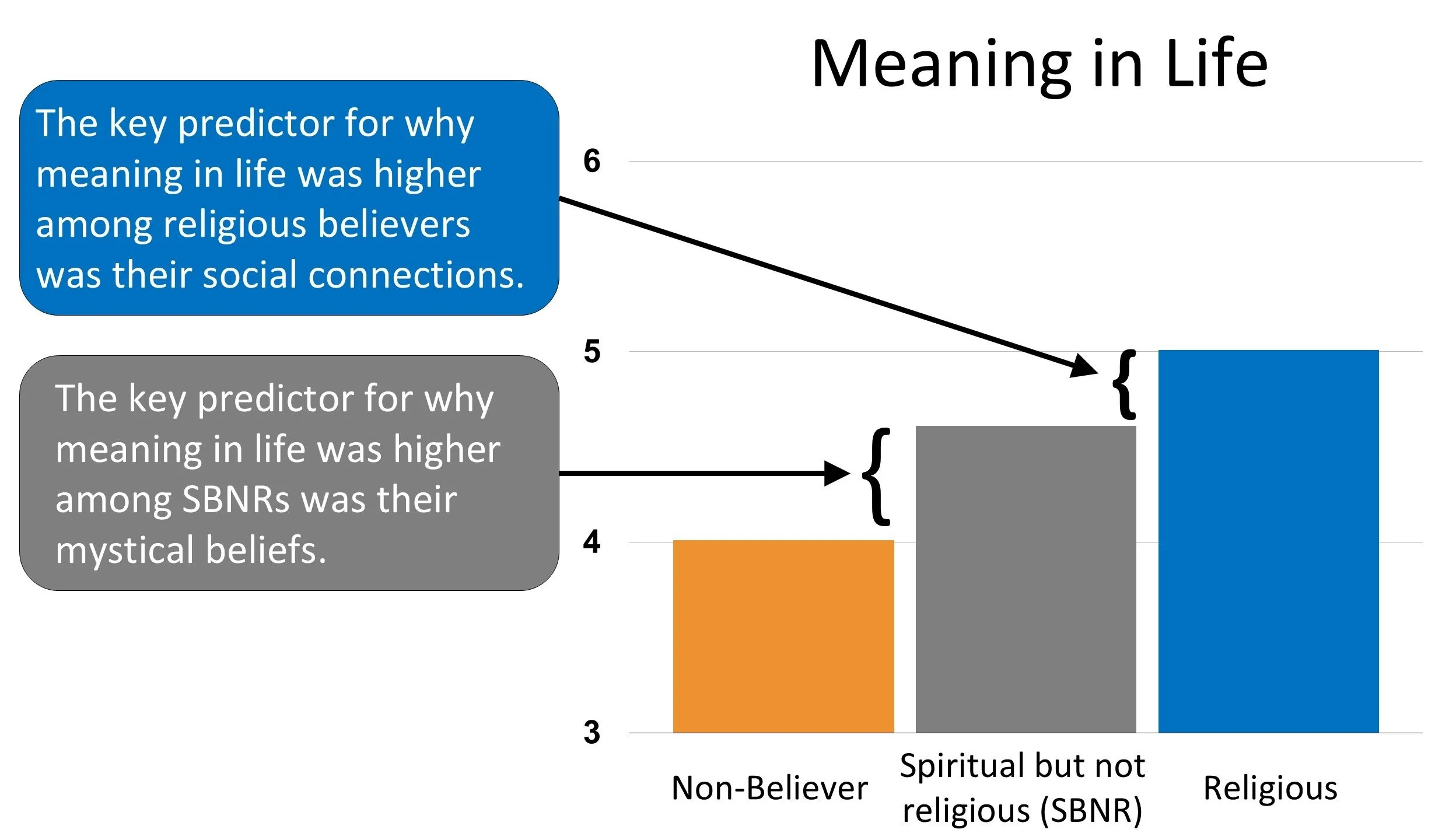
Research compared people’s meaning in life across three different groups of American adults: religious people, spiritual but not religious people, and non-believers (Jettinghoff et al., 2025).
We sought to understand why meaning in life was higher among the religious and the spiritual but not religious compared with the non-believers. We measured people’s social connections and found that religious people were more socially connected than the other groups. Moreover, comparing the heightened level of meaning in life among religious believers over the spiritual but not religious revealed that it was religious people’s higher level of social connections that mediated their greater meaning in life – those who reported more social connections felt that their lives were more meaningful. These findings largely fit with past research (e.g., Salsman et al., 2005), although they don’t explain why the spiritual but not religious felt more meaningful than non-believers.
We also surveyed participants in terms of the various supernatural beliefs that they held, such as beliefs in karma, the law of attraction, or universal connectedness. Not surprisingly, we found that both the religious and the spiritual but not religious reported more supernatural beliefs than the non-believers. In addition, we found that people’s supernatural beliefs mediated the heightened level of meaning in life of the spiritual but not religious over the non-believers. That is, the more that people reported holding various supernatural beliefs, the more likely they were to report that their lives were meaningful. Somehow believing in things such as the law of attraction or universal connectedness was associated with a more meaningful life.
We replicated all of these findings in a second study with a sample from a more secular country – the UK. These findings suggest that the social connections gained from sharing supernatural beliefs are associated with greater meaning in life.
Science as a Meaning System
Although many people who eschew religions turn to alternative kinds of spiritual belief systems, another obvious competing perspective to religion is provided by science. Science would seem to offer some of the same benefits as religions, in that it offers a worldview that can help to explain what is happening around us, and that it can help to allay our anxieties by providing solutions to many of the problems that we currently face, such as by helping to rapidly create an effective vaccine against COVID-19. Given the increasingly central role that science has played in people’s lives since the Enlightenment, we might question how well science can help address people’s existential needs.
We sought to explore this by examining the relations between people’s attitudes towards science and their meaning in life (Folk et al., 2025). We provided participants, who in one study were all employed in science and technology fields, with a number of different scales that tapped into their attitudes about science, and we identified three underlying factors for these. The first factor we termed scientific optimism, and it reflected the view that science improves people’s lives by solving various problems. A second factor we termed scientism, and it reflected the view that science is the only legitimate way of providing explanations of the world. And a third factor, which we termed scientific reductionism, assessed how much people were comfortable with the notion that everything has a material basis, and is constructed of atoms and molecules.
We assessed how these different scientific attitudes related to people’s feelings of meaning in life. One factor, scientific optimism, was positively associated with people’s meaning in life. It seems that viewing science as a tool to improve our lives is associated with greater meaning in life. In stark contrast though, we found that people who endorsed more of the items regarding scientism and scientific reductionism reported lower meaning in life. That is, the more that science was seen as the only legitimate way of understanding the world, and the more that people denied the role of any non-material factors, the less likely they were to view their lives as meaningful, although it should be emphasized that these relations were rather weak.
It was even more striking that we found these relations in a sample of people employed in scientific fields, as it seems that these people should see science as playing an especially critical role in their lives. This points to further evidence that meaningful lives appear to be facilitated by maintaining supernatural and non-materialist beliefs.
The Power of the Supernatural
Supernatural beliefs, a cultural universal that is found in all societies of the world, remain somewhat of a puzzle. While some argue that humans are compromised by maintaining such irrational beliefs, a growing amount of research is finding that these beliefs are associated with a number of existential benefits. Believing that there is more to the world than the material aspects that we can detect with our own senses curiously comes bundled with greater feelings of meaning in life. How these beliefs get tangled up with these benefits is not immediately clear, and is a question that warrants much further investigation. These findings suggest that we should be cautious in urging people to abandon their supernatural beliefs. By turning to an exclusively rational account of what is happening in our lives we may be giving up something that is crucial to our well-being.

Dr. Steven J. Heine is Distinguished University Scholar and Professor of Social and Cultural Psychology at the University of British Columbia. His research focuses on a few topics that converge on how people come to understand themselves and the world around them. In particular, he studies how people’s cultures shape how they make sense of themselves and their worlds, how people strive to find meaning in their lives, and how people understand genetic causes. He is author of “Cultural Psychology”, the top-selling textbook in its field, and the trade book, “Start Making Sense: How Existential Psychology can Help Build Meaningful Lives in Absurd Times” (Basic Books, 2025). He is a Fellow of the Royal Society of Canada.