
Megan Edwards on adversity, hope, and meaning
Dr. Megan E. Edwards is a Postdoctoral Scholar at Duke University, working with Patty Van Cappellen. Megan completed her Ph.D. in Psychology at the University of Missouri, Columbia in 2024 as a Life Sciences Fellow under the co-mentorship of Laura King and Jamie Arndt. She received her B.A. in Psychology and Neuroscience at Hope College in 2017. Dr. Edwards is a social, personality, and affective psychologist, specializing in the intersection of emotion and existential psychology. Her research investigates the role of everyday emotion in answering ‘big’ existential questions (e.g., does my life have meaning?) and how people flourish in the face of adversity. Her current work focuses on the emotions of hope and awe.
Megan on the web: Google Scholar | Website
By Daryl Van Tongeren, Hope College. April 12, 2026.
ISSEP: How did you first become aware of and interested in existentialism and the science of existential psychology?
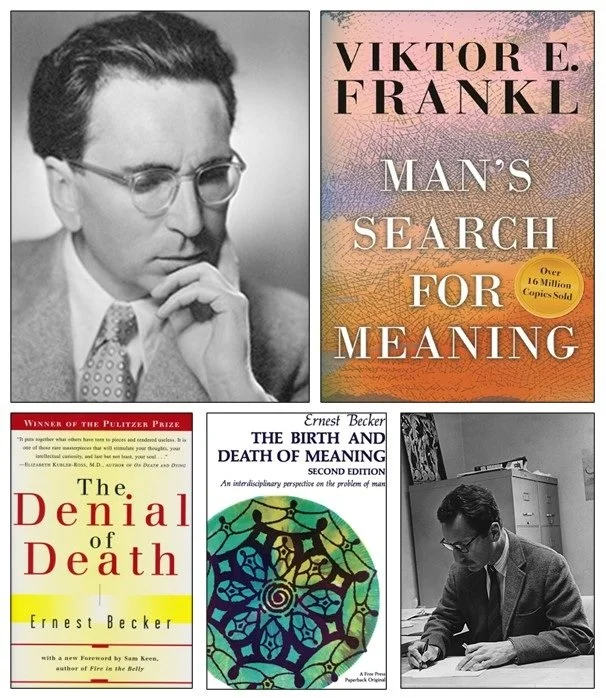
Megan Edwards: I got really engaged with asking questions about meaning. I ended up taking a class at Hope College, taught by Daryl Van Tongeren, on the psychology of meaning. We discussed theories around meaning, such as terror management theory. It was a really reflective class, which I really enjoyed. We wrestled with these big ideas that apply to our lives in so many ways. Through that class, we read Viktor Frankl's Man’s Search for Meaning (1946), and that book really resonated with me and how I saw the world, especially in regard to suffering.
For example, I studied abroad in Rwanda in college, and this is a country that has lived through a genocide within my lifetime. Everybody my age and older is essentially a survivor of significant suffering and devastation—extreme suffering. To be able to witness how so many people were flourishing in their lives after such devastation was a very impactful experience. I think that's why meaning in life has always really spoken to me, because hardship so strongly affects our well-being and happiness, but we humans are somehow still capable of finding life to be meaningful, just as Victor Frankl wrote about. I just knew that I wanted to be doing research in that area and make that a focus.
Moving into the world of existentialism, I read Ernest Becker’s Denial of Death (1973) and The Birth and Death of Meaning (1971), and I knew at some point, when I went to graduate school, I really wanted to be working with people who were in the in the world of existential psychology. Blending that with my research on positive emotion, I really see myself as a positive existential psychologist.
ISSEP: You’ve been doing some great research in existential psychology lately. Can you tell us more about your work?
Megan Edwards: The primary area I'm studying right now is hope. I do a lot of work with awe too, within existential psychology, but hope is what I'm most excited about. A lot of my work has been looking at how hope is a mechanism for making meaning, particularly during difficult life events—essentially, when meaning is being threatened. I consider hope to be a very existential emotion or resource. So, a lot of my work draws a line between hope and meaning.
Consider this: All of the things that we know that help people create meaning are also in some way linked to hope. Positive emotions impact meaning, and hope is a positive emotion. Hope helps us relate to and understand ourselves and our values. Hope is a part of our worldviews and is embedded in religion. It is a future-oriented emotion that helps connect our past and present and future selves. I’ve been building the theory around hope as a meaning making emotion, and most of my empirical work has sought to establish hope as a unique positive emotion compared to others in the relationship to meaning.
I have found that, cross sectionally and through daily diary studies, hope predicts greater meaning in life, above and beyond other positive emotions. Hope has a unique and specific relationship to meaning, both motivationally and affectively, and offers a unique contribution in addition to agency and pathways. Longitudinally, we see that hope is the only positive emotion that predicts future meaning in life; it has lasting, not just momentary, effects.
Within all of this work, we see that for people who are struggling with depression, or report greater feelings of despair or loneliness, or have had more traumatic, adverse childhood experiences, hope is a stronger predictor of meaning than people who are not experiencing these kinds of struggles. Adversity appears to make the link between hope and meaning even stronger, which are the times where we need hope the most. So, we pull hope out of our tool belt, and that's when we use it.
ISSEP: Your work is valuable and timely. How did you develop your interests in hope?

The mythological phoenix’s rebirth from its own ashes is a potent symbol that despite suffering and death one may always hope for a better tomorrow.
Megan Edwards: I witnessed suffering and was amazed at how people still find life meaningful. I wanted to ask the question: How do we do that? What is the catalyst for meaning in suffering? I got connected to Laura King, who studies positive emotions, and she herself was interested in hope. We had several conversations around how hope could be a mechanism by which we make meaning. So, I would say it was a combination of witnessing the world in front of me, and also being surrounded by other researchers who are kind of interested in the same things, planting seeds in my head. It sparked something in me.
ISSEP: In what ways can your research help us make sense of important human experiences, better understand important events, or inform our cultural or technological trends?
Megan Edwards Right now, especially watching what's happening in the US, we need hope. Regardless of people's religious or cultural backgrounds, people tend to agree that, suffering is a natural part of the human experience that can’t be avoided. A persistent question we humans have is: How can I make sense of this? How can I find my purpose amid all of this?
The future is so uncertain, and so I think that hope is just so relevant right now, and it's such an important tool. It's motivating and future-oriented, and it enables us to hold on to the belief that things can get better. It’s a way that we can continue to thrive and survive. Hope offers a sense of surety or certainty for something that is truly uncertain. It helps to relieve our existential anxieties.
ISSEP: Do you see these topics when you look at the arts and humanities?
Megan Edwards: Yes! I consistently see that hope comes up in poetry, art, and music. Hope is everywhere. It’s something that humans are really drawn to, even if they don't have it, and it's because they want it and need it. Art in general is one way of expressing meaning in life, and what we see as meaningful.
One example is of course how hope comes up in books and stories. In which case, I will of course have to highlight The Lord of the Rings. Frodo is sure to fail at destroying the ring, and yet Gandalf continues to hold on to hope and does not let despair get the better of him. He has no idea where Frodo is or if he’s close or dead, but Gandalf continues to move forward with his own plans of saving Middle Earth, believing that Frodo will succeed. Tolkien does a good job of portraying how humanity will hold onto hope even for the least likely of outcomes, I think, because it is a part of being human. It’s something we need in the face of war, poverty, and personal sufferings.
I also notice hope as a theme under songs more often now. Andra Day’s “Rise Up” is a beautiful tribute to resilience and overcoming adversity.
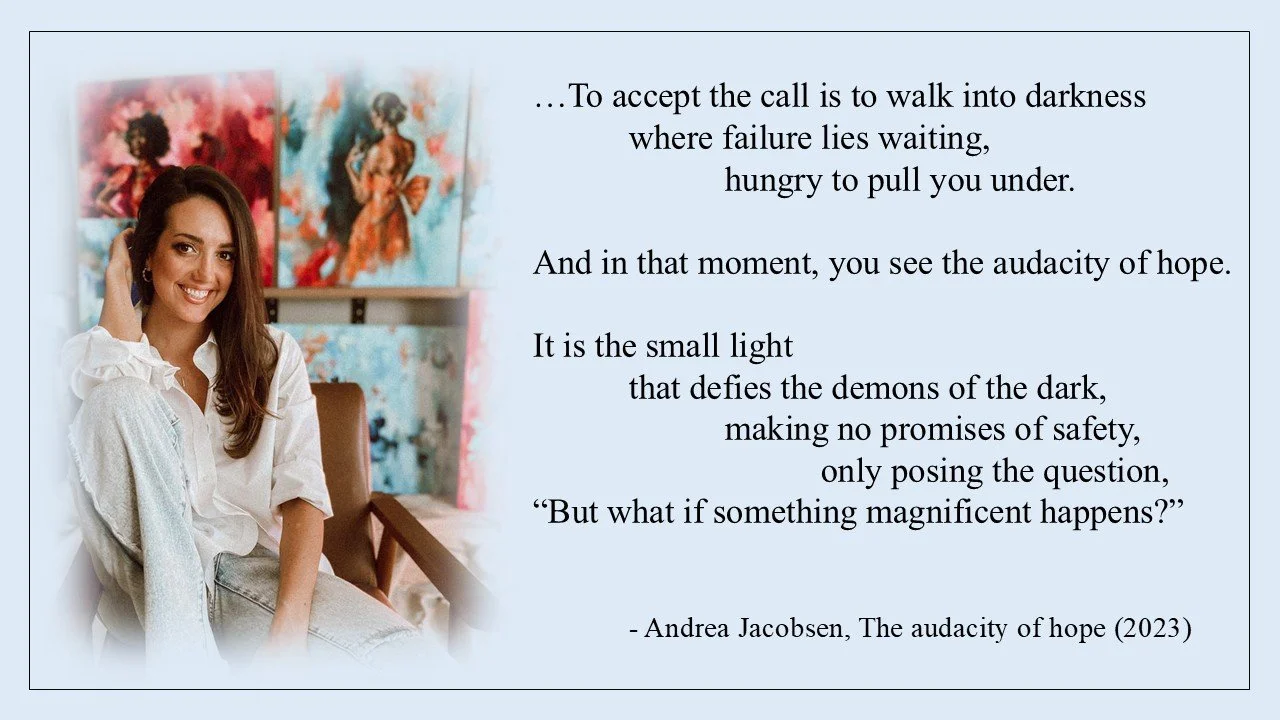
Also, an artist I follow on Instagram, Andrea Jacobsen, is doing a series of 100 paintings of women in dresses. One of her paintings is called The Audacity of Hope and it is paired with a poem that I find super beautiful and poignant – daring someone to hope: “But what if something magnificent happens?”
ISSEP: What do you think are some important next steps toward better understanding these experiences?
Megan Edwards: I'm starting to draw a line between hope and meaning, but we need to understand why there's a strong connection. Right now, the work is still very theoretical, so a lot of work could focus on understanding why there is such a strong connection between hope and meaning. So, focusing on the mechanisms would be valuable.
I have also been thinking about the importance of collective hope—a shared hope amongst a community of people. How does that play a role in taking collective actions as a group, in societies? We can move beyond hope within the individual, which is usually where it's focused, and start thinking about hope in a group. In a way, collective hope is probably the only reason that we ever make progress in huge social problems, like racial inequalities, because it's such a big fight, an impossibly large fight, that has taken years and will continue to take years. But the fact that that collective hope remains is how we continue to take tiny, tiny steps forward, because otherwise, so many people may be ready to give up.
I’ve also been thinking about the dark side: when hope might be not so good. When what you're hoping for doesn’t happen or when we don't get what we're hoping for, our worldview or expectations crumble a little bit. This may be threatening, beyond merely a sad feeling. What are the existential implications? How does hope relates to the broader area of existential psychology, outside of meaning? Might hope be a key existential emotion?
What other “big questions” does hope help us answer, or anxieties that it helps us resolve? I think about uncertainty a lot, and how hope helps us of resolve anxieties about uncertainty. I think there are a lot of areas that hope fits within existential psychology. And in my mind, existential psychology can be a positive practice; what are the positive implications of hope, beyond coping with death and meaninglessness.
ISSEP: You have presented at the ISSEP Preconference. How was that experience?

Megan Edwards: So far, my experiences have been really great. It always ends up being one of my favorite preconference experiences every year. To me, the topics are always interesting, even if it has nothing to do with what I study directly. I find myself saying “Oh, that was really cool! I enjoyed that one too!” As a whole, the preconference has become a place where I feel real sense of community and I’ve developed so many good relationships. After being virtual so many times, experiencing an in-person preconference has allowed me to actually meet people face to face that I hadn’t ever had an in-person interaction with before, which is amazing. The preconference as a whole does a good job of making it feel like a community, where you can build connections, learn from the various presenters and meet with people who are in my same career stage. It allows these great collaborations to form by simply facilitating ways to make those connections happen, through the happy hour, the dinner, or opportunities for informal conversations.
ISSEP: What's one piece of advice you would give to future students who have an interest in following in your footsteps so they can make innovative contributions to the science of existential psychology like you have?
Megan Edwards: Existential psychology is getting at the heart of the human experience. I would always recommend students to just study whatever it is that they're drawn to about the human experience, and whatever wows or shocks them; essentially what they find to be meaningful to study, because I think the research process is amazing. Getting to ask questions and trying our best at answering them is exciting.
However, you have to understand that this field is really hard and has many demanding aspects. Your research never goes perfectly, and you have to deal with reviewers who are critical. So, you have to prepare to handle all of that. To do so, I think you should really pick something that you truly enjoy and find meaningful.
We should all go live meaningful lives, and we should do it in our work, and that's what makes the field worth it, right? So, I find meaning meaningful, and other people can find other things meaningful. Take the time to figure that out what feels meaningful for you to study. Don't feel rushed to dive into anything too soon, because the people who end up dropping out of graduate school or end up switching to something different usually end up doing so because they found their original pursuit ultimately unfulfilling. So, it’s an important first step to make sure to identify what questions you would find fulfilling, and that can take as long of a process as it needs to take.
I’d also recommend finding the right community of people who are also interested in what you do, and where you get to think about those ideas together. To me, that's a big draw. Otherwise, if I’m just doing this by myself all the time, it would lose its exciting nature. To get to work together with other people is what makes thinking interesting.
“Take the time to figure that out what feels meaningful for you to study and find the right community of people who are also interested in what you do, and where you get to think about those ideas together.”
ISSEP: Can you tell us a little about yourself outside of the work or research context?
Megan Edwards: I'm a very outdoorsy person. I just trying to get outside as much as I can. I love camping and hiking and finding those little moments of awe in everyday life. I'm a very big crafter. I go through phases where I have my next project or where I learn a new skill that I can do with my hands. So, I've done a lot of pottery, glass cutting, and knitting.
I’m also an avid reader. I find it really hard to read physical books, probably because we read and write a lot in our jobs, and so I don't enjoy staring at words on a page, so I consume a lot of audio books and have a lot of fun listening to audiobooks. And I mostly listen and read fantasy and sci fi. I very much love to escape into different worlds and systems.
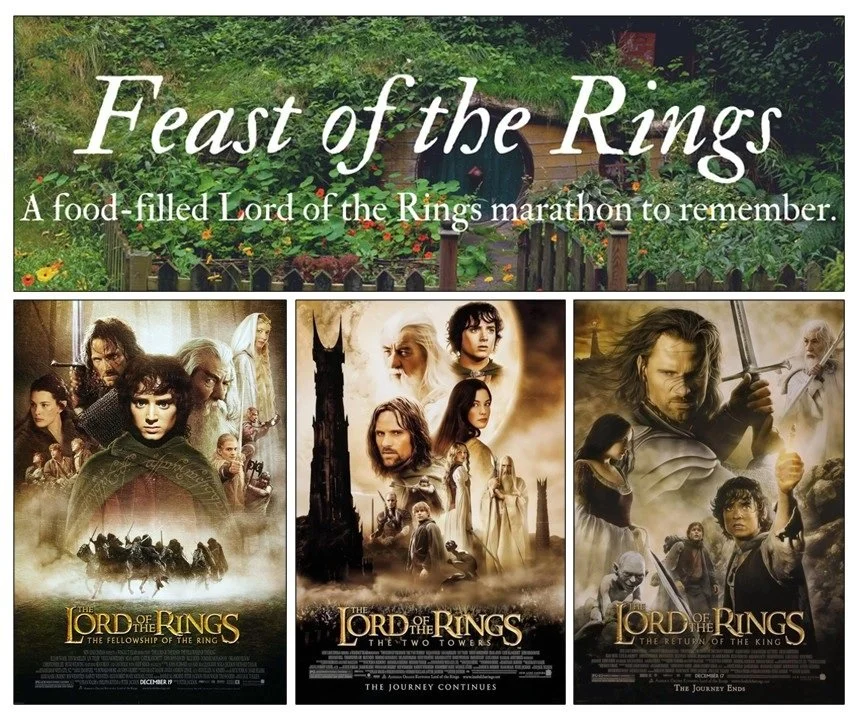
And, I'm a diehard Lord of the Rings fan. I've probably read those books so many times, and now I do activities that are Lord of the Rings oriented. In graduate school,, I got everybody to do a Lord of the Rings extended edition marathon with me, which is about 12 hours. And over this 12-hour event, I made sure that we ate all of the food that they eat in the movies while watching the movies at the same time that the characters were eating. I had to do research to put this together. For example, in the beginning, Bilbo makes tea and breakfast when he's sitting with Gandalf, so we had coffee cake and tea and coffee, and maybe eggs and toast. And then, the characters were making sausages while on the run with Aragon and he gets mad, so then we're eating sausages and we're eating lembas bread. We had an entire roast chicken because there’s a scene where a chicken is floating in the water after floods. It ends up being a lot of food, so I recommended that people eat very small portions!
ISSEP: A lot of us like to listen to music while working or otherwise, what are you listening to lately?
Megan Edwards: I'm one of the weirdos of the world who like working in silence. For some reason, I get distracted by music. So, I tend not to listen to music while working. However, if I must listen to something while working, I will listen to pop music instrumentals.
But, for life in general, I tend to pick Spotify playlists based off of the mood that they're describing. One of the playlists is called “warm and fuzzy feelings.” It puts together songs that truly offer a warm and fuzzy feeling. Sometimes I need more, intense, heavy rock or something, and so I look for that sort of mood or vibe, and let it pick the music for me.
My favorite artist is Sleeping at Last, which is somebody who I think many people haven't heard of. It is very rich in lyrics, so it is very unique. The songs have specific themes, and he’s written songs for all of the senses and all the planets. Saturn is my favorite of his and generally most popular. The lyrics are really meaningful and deep, all about different types of experiences. It’s something where you want to pay attention to the words rather than just let it play in the background. One of my favorite lines in Saturn is, “How rare and beautiful it is that we exist.”