
Julia Lombard on self-transcendent values and intergroup cohesion

Julia Lombard is a Ph.D. student in social psychology at Florida State University. She earned her B.A. in Psychology with a minor in Evolutionary Studies from the State University of New York at New Paltz in 2024. Her research examines how value affirmation and self-transcendent states, such as awe, shape social perception and interaction, particularly in contexts involving intergroup anxiety and threat. She is especially interested in how these processes might foster intellectual humility, reduce biased social perceptions, and promote more positive and cohesive intergroup interactions. Her work draws on perspectives from social cognition, motivational psychology, and evolutionary psychology. Outside of research, Julia has a background in musical theatre and enjoys singing, as well as spending time outdoors and staying active.
Julia on the web: Lab Page | LinkedIn | GoogleScholar
By Nicholas Kelley, University of Southampton. April 19, 2026.
ISSEP: How did you first become aware of and interested in existentialism and the science of existential psychology?

Julia Lombard: I first became interested in existential psychology during my senior year of undergraduate study at SUNY New Paltz. I was completing an honors thesis in which I took an evolutionary psychological approach to studying awe. I found that participants with a relatively slow life history strategy, that is, those prioritising growth, development, and long-term survival over immediate reproduction, reported experiencing awe more frequently. My background up to that point had been largely in evolutionary psychology, so I was already interested in the functional role of emotions. I then came across work on awe from a functionalist perspective, which led me to think more deeply about experiences such as self-transcendence, connectedness, and meaning.
From there, I became increasingly interested in how these psychological states relate to broader existential questions, including purpose, values, and how people situate themselves in the world. Although my current work focuses more on intergroup processes and social cognition, I have continued to integrate these earlier interests into my research, particularly around meaning-making and self-transcendence.
ISSEP: You’ve been doing some great research in existential psychology lately. Can you tell us more about your work?
Julia Lombard: Currently, I examine how value affirmation shapes intergroup interactions, particularly under conditions of anxiety and perceived social threat. This work is grounded in self-affirmation theory, which proposes that people are motivated to maintain a sense of themselves as adequate, capable, and moral. When that sense of self is threatened, for example through negative feedback or uncertainty, individuals often respond defensively. In intergroup contexts, this defensiveness is frequently rooted in intergroup anxiety, especially concerns about appearing prejudiced or socially incompetent. Ironically, these concerns can undermine the interaction itself, as individuals become overly focused on managing impressions rather than engaging openly with their partner. I examine whether affirming a personally important value can buffer against these kinds of self-presentational threats.
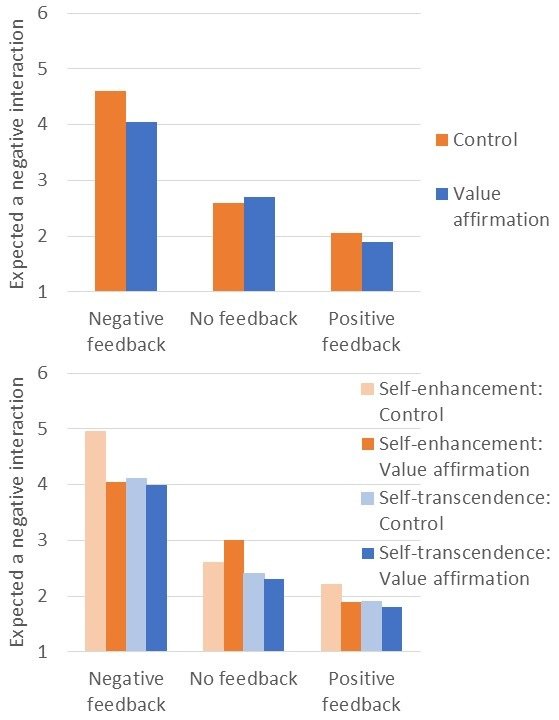
Upper panel: Affirmed participants were less likely to expect that they would be perceived negatively or judged as prejudiced. Lower panel: Participants who reflected on self-transcendent values reported more positive interaction expectancies than those who focused on self-enhancing values, regardless of if their values were affirmed or not.
To examine these ideas, I conducted a large online study in which participants completed either a value affirmation or a control writing task and were then led to believe they would engage in an interracial interaction. I manipulated feedback from an ostensible interaction partner to create conditions of positive, negative, or no feedback, thereby inducing varying levels of intergroup anxiety. In a typical value affirmation exercise, individuals reflect on a core value and consider how it gives their life meaning, guides their behaviour, and connects to their sense of identity. This process is thought to reinforce a broader sense of self-integrity, allowing people to respond to specific threats in a less defensive way.
Building on this paradigm, a key question in my work is whether the type of value people affirm matters. I distinguish between self-enhancement values, such as status, success, or appearance, and self-transcendent values, such as compassion, connection, and contributing to something larger than oneself. Self-transcendent values, in particular, may shift attention away from self-presentation and toward a more expansive, other-oriented perspective.
I found that value affirmation may help individuals maintain a sense of control over how an interaction will unfold, even in the face of negative feedback. Affirmed participants were less likely to expect that they would be perceived negatively or judged as prejudiced, suggesting that affirmation buffers against the loss of perceived agency that often accompanies intergroup anxiety. Importantly, the type of value also mattered. Participants who reflected on self-transcendent values reported more positive interaction expectancies than those who focused on self-enhancing values, regardless of if their values were affirmed or not, suggesting that adopting a more other-oriented, self-expansive perspective may be especially effective in reducing defensiveness in intergroup contexts.
ISSEP: Fascinating! How did you develop your interests in this topic area?
Julia Lombard: My interest in this topic developed gradually as I transitioned into graduate school and began working in a lab focused on motivated social cognition and interpersonal interactions. I was already interested in emotions like awe. Specifically, the idea that awe makes the self feel small compared to things like the vastness of nature or the cosmos, which naturally connects to self-transcendence. When I started thinking about intergroup interactions, it became clear that many of the challenges people face in these contexts are rooted in concerns about the self, especially how one is perceived by others. That connection made it feel natural to bring together value affirmation and self-transcendence with intergroup dynamics. I became particularly interested in how different ways of construing the self might influence how people respond to social threat.
ISSEP: In what ways can your research help us make sense of important human experiences, better understand important events, or inform our cultural or technological trends?

Julia Lombard: I think this work is especially relevant for understanding why interactions across social differences can be so difficult, even when people have good intentions. In many contemporary contexts, whether in discussions of race, identity, or other group differences, people are navigating situations where they want to be respectful and open-minded but are also highly concerned with how they might be judged. That tension can produce heightened self-monitoring and anxiety, which paradoxically makes interactions feel less natural and less positive. My work helps make sense of this experience by showing that a key part of the difficulty lies in how people regulate threat to the self. When individuals feel uncertain about how they will be perceived, they can lose a sense of agency in the interaction and become overly focused on managing impressions rather than engaging with the other person.
Our findings suggest that value affirmation can help interrupt this process. By reinforcing a broader sense of self, particularly through values tied to meaning and connection, individuals might be less likely to anticipate negative evaluation and more able to engage openly with others. More broadly, this work speaks to how people navigate social environments where group differences are highly salient. It suggests that small shifts in how individuals relate to the self, especially moving from self-presentation toward a more self-transcendent perspective, can meaningfully shape social interactions.
ISSEP: Do you see your research topic when you look at arts and culture?
Julia Lombard: Yes, I do see these processes reflected in arts and culture, particularly in how people express and relate to the self. One aspect I find especially interesting is that self-affirmation may not only occur through writing about values, but also through behavior. Acting in line with a core value can itself be affirming, because it reinforces a sense of identity. Artistic expression may be a particularly powerful context for this, as it allows people to enact and embody what matters to them. A recent example that stood out to me is the figure skater Alysa Liu. She stepped away from competitive skating at a very high level when it stopped feeling like a form of expression and became more about external expectations, how she should present herself, what she should wear, and how she should perform. When she returned, it was on her own terms, with a focus on enjoyment and self-expression rather than perfectionism or evaluation.

What I find especially compelling about her story is how much it resonates with my own experience. I had a background in musical theatre and classical singing, and at one point I was on a fairly structured path to pursue classical voice more seriously. I ended up taking a hiatus from singing because it no longer felt enjoyable. When I returned to it during college, I made a deliberate decision not to pursue it in a formal or highly structured way. Instead, I engaged with it on my own terms. I joined an a cappella group, became the music director for a few years, and took classes and private lessons, but approached all of it in a way that did not feel like work. That shift, from engaging in something to meet expectations to engaging in it as a form of self-expression, feels closely aligned with the kinds of processes we study in value affirmation. It is interesting, I even came across a comparison of Alysa Liu to Nietzsche’s idea of the Übermensch, which, in a way, captures this movement beyond external constraints and toward something more self-defined.
As a musical theatre fan, I also find myself thinking about how some of my favourite productions connect to these ideas. For example, The Phantom of the Opera, which is one of my favourites, captures something closer to self-transcendence in a more experiential way. The aesthetics are very intense and, for me at least, really awe-inducing. I still remember seeing it live for the first time and feeling completely overwhelmed. Moments like the falling chandelier, the candlelit descent to the Phantom’s lair, and the way characters appear and disappear create this immersive, almost otherworldly experience. Even the Phantom himself evokes a blend of fear and wonder. He is a musical genius with a lot of darkness, but also someone who is deeply isolated and still yearning for connection.
A close second for me is Les Misérables, which probably reflects these themes more directly. The main character, Jean Valjean, undergoes a really profound transformation after an act of unexpected mercy and shifts from a life focused on survival to one grounded in prosocial purpose, compassion, and forgiveness. Throughout the story, he consistently acts in ways that go beyond his own immediate needs and instead serve others. In that sense, he really embodies these more self-transcendent values, like responding to others and contributing to something larger than the self. His behaviour also reflects a kind of value-consistency, which is something I think is central to how affirmation works in promoting resilience and flexibility.
ISSEP: What do you think are some of the remaining issues in this area, and what are the most important next steps?
Julia Lombard: One important next step is to move beyond self-report measures and examine behavioural outcomes. So far, much of this work focuses on how people expect interactions to unfold, but we are increasingly interested in how these processes translate into actual behaviour, such as how people engage with others, what they attend to, and how they respond in real time. Another key question is the extent to which these effects generalise across different types of group relationships. My current work focuses on racial groups, in part because it provides a clear and well-studied context for intergroup anxiety. However, one could examine these group processes more broadly, including whether similar effects would emerge in contexts such as political groups or gender.

Related to this, an important issue is whether the nature of the threat differs across groups. In my work, the threat or anxiety is largely tied to self-presentation concerns, such as wanting to avoid appearing prejudiced. In other contexts, the threat may take a different form. For example, individuals from historically marginalised groups may be more concerned about confirming negative stereotypes about their group. Because value affirmation has been shown to buffer stereotype threat, it is plausible that similar mechanisms would operate, but this remains an open empirical question.
ISSEP: You’ve attended and presented research at our Existential Psychology Pre-conferences; how has your experience been with those?
Julia Lombard: Last year was my first SPSP and my first time attending the Existential Psychology Pre-conference. It was a really great experience. It was actually the only pre-conference I attended, and what stood out most was being surrounded by people who were interested in the same kinds of questions. It made me realise that I was not just working within my own small research bubble, but that there is a broader community of people thinking about similar ideas, asking similar questions, and approaching them in different ways.
One moment that really stayed with me was when someone said that as long as we exist, there will always be something to study in existential psychology. That idea really resonated with me. As long as people are grappling with questions about meaning, purpose, and how they are connected to something larger than themselves, there will always be more to understand. These are not questions that have final answers, and in some ways, that is what makes the field so compelling. I found that perspective really motivating. It shifted my focus away from trying to arrive at definitive answers and more toward embracing the process of exploration.
For me, what is most engaging about this area of research is the opportunity to keep asking questions and to continue following that curiosity. There is something powerful about studying questions that are inherently open-ended, because it means the work is always evolving. I am looking forward to being there and presenting next year!
“Try to find gaps where an existential perspective has not yet been applied... think outside the box... Some of the most interesting work comes from bridging areas that are not typically brought together”
ISSEP: What is one piece of advice you would give to future students who have an interest in following in your footsteps?
Julia Lombard: I would say, especially for existential psychology, try to find gaps where an existential perspective has not yet been applied. One thing I have found in my own work is that some areas of the literature can feel a bit unclear or inconsistent, and part of that may be because they are not being approached from an existential lens. For example, in value affirmation research, thinking about values in terms of self-transcendence versus self-enhancement opens up new ways of understanding the process. So, I think a really valuable approach is to take a question or problem you care about and ask how an existential perspective might offer something new.
More generally, I would say be creative and think outside the box. Look for connections that have not yet been made, and do not be afraid to explore ideas that feel a little unconventional. Some of the most interesting work comes from bridging areas that are not typically brought together. I would also say to stay curious and to enjoy the process of exploration. For me, what makes research feel right is being motivated by the questions themselves rather than just the outcomes. If you find yourself genuinely enjoying the process of working through a problem, even when it is challenging or unclear, that is a good sign.
Related to that, I think it is important to be open to unexpected findings. Some of the most exciting results are the ones that are not intuitive, because they push us to rethink our assumptions. If we already knew the answers, we would not need to do science in the first place. So, I think my main advice would be to stay curious, be open, and enjoy the puzzle. That is really what makes this kind of work so engaging.
ISSEP: Can you tell us a little about yourself outside the work/research context?

Julia Lombard: Outside of research, a big part of my life has been music. I have a background in musical theatre and classical singing, and for a long time I was on a fairly structured path to pursue classical voice more seriously. Around the time I graduated high school in 2020, I ended up taking a step back from singing. It had started to feel more like something I was working at rather than something I genuinely enjoyed. When I came back to it later in college, I approached it very differently. Instead of pursuing it in a formal way, I engaged with it more on my own terms. I joined an a cappella group, eventually became the music director, and took lessons and classes just because I wanted to.
That shift really changed how I related to it. It became something I did because I enjoyed it, rather than something I felt I had to do in a particular way. Right now, with grad school, music has taken a bit of a back seat, but it is still something I stay connected to. My family is very musical, so whenever we get together, we tend to sing and collaborate, which is a really nice way of keeping that part of my life present.
Outside of music, a lot of my time is spent doing things that get me out of the office. I do a lot of hot yoga, Pilates, strength training, and walking, and I try to take advantage of the trails in Tallahassee to spend time in nature. Lafayette Heritage Trail Park is probably my favourite spot right now. I also try to travel to nearby hiking areas when I can. For example, I am planning a trip to Providence Canyon in Georgia with some friends, which I am hoping will be a very awe-inducing experience. That has been a really important outlet for me during graduate school.
ISSEP: A lot of us like to listen to music while working/studying, and in general. What are you listening to lately?
Julia Lombard: Yes, I definitely have a study playlist. I have found that listening to music with lyrics can be a bit distracting when I am working, so I tend to gravitate toward more instrumental or softer styles. I have a classical playlist that I often return to, which includes a lot of the music my mom used to play for me when I was growing up. There is something about that sense of familiarity and nostalgia that helps me focus. I also have another study playlist (here) that has more of a cozy, bluesy, jazz, coffee shop kind of feel.
Lately, I have been listening to artists like Olivia Dean and Amy Winehouse, who are probably some of my favourite artists. Winehouse’s music feels very nostalgic to me, and I am always struck by how expressive she is. Some of the artists I tend to return to are Norah Jones, Billie Holiday, and Ella Fitzgerald. I also listen to Alice Phoebe Lou, whose music has a very soft and calming quality. Overall, I think my music taste while working is less about specific genres and more about creating a certain atmosphere. I tend to gravitate toward music that feels warm, familiar, and a little nostalgic, something that helps me settle into what I am doing.